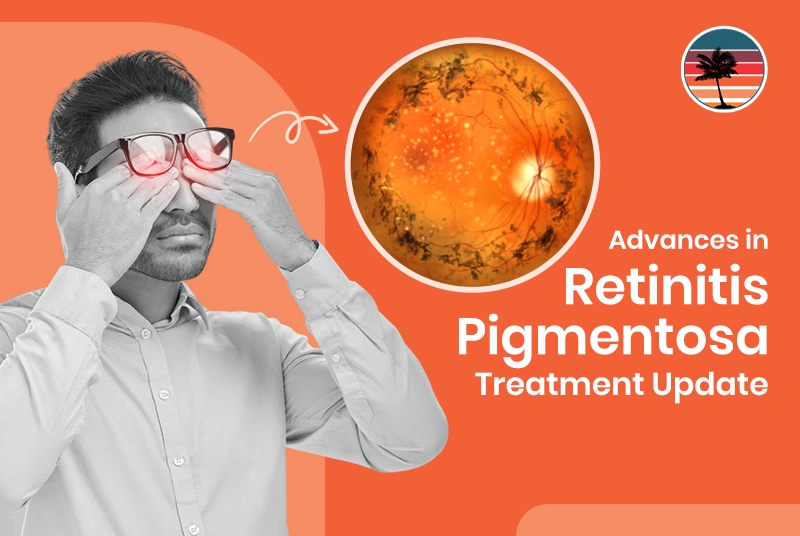
Do you struggle with night vision or occasionally bump into things? If you’re living with retinitis pigmentosa, you may carry a constant awareness of your changing vision—wondering when the next part of your sight might fade.
You are not alone. Retinitis pigmentosa affects approximately 1 in 4,000 people worldwide. Many individuals share your concerns and emotions as they cope with the uncertainty and emotional challenges of progressive vision loss.
But there is hope. Researchers are making remarkable progress, and new treatments for retinitis pigmentosa—and related conditions—are emerging. For the first time, there is genuine promise across a spectrum of retinal diseases.
FDA-Approved Gene Therapy
Luxturna is the only FDA-approved gene therapy for retinitis pigmentosa. This single-application treatment is for patients whose retinitis pigmentosa is caused by mutations in the RPE65 gene. The FDA approved Luxturna in December 2017, an essential milestone in the treatment of hereditary retinal dystrophies.
Luxturna treats the patients by inserting a copy of the RPE65 gene directly into the retinal cells. Some patients report seeing stars, reading again, and recognizing faces. These performance levels remained elevated for at least three years in clinical trials.
Optogenetic Therapies Are Encouraging
Optogenetic therapy offers a novel, mutation-agnostic approach for retinitis pigmentosa treatment. In simple terms, it works regardless of which genetic mutation causes the patient’s condition.
MCO-010, developed by Nanoscope Therapeutics, is a gene therapy approved to restore light sensitivity in the patient’s remaining retinal cells. MCO-010 targets the bipolar cells in the retina that can sense light, even after the photoreceptor cells have died.
Recent results from a two-year study showed that nearly 50 per cent of patients improved by three lines on a standard eye chart. The process involves a single injection and does not require special glasses or light-amplification devices. The FDA has granted Orphan Drug and Fast Track designations for MCO-010 for the treatment of retinitis pigmentosa and Stargardt disease.
Gene Therapies in Clinical Trials
Multiple gene therapies are in clinical trials for treating retinitis pigmentosa, including botaretigene sparoparvovec. They serve to treat X-linked retinitis pigmentosa caused by mutations in the RPGR gene. The Phase III Lumeos trial recently concluded, accruing subjects in 2023. OCU400 from Ocugen is another example of a mutation-agnostic therapy targeting the NR2E3 gene and is in Phase III trials.
Other therapies include AGTC-501 from Beacon Therapeutics, GS030 from GenSight Biologics, and 4D125 from 4D Molecular Therapeutics. CTx-PDE6b from Coave Therapeutics is in Phase I/II trials. It aims to slow or halt retinal degeneration in patients with PDE6B deficiency.
N-Acetylcysteine (NAC) Oral Treatment
Johns Hopkins University initiated a Phase III clinical trial of N-acetylcysteine (NAC) to treat retinitis pigmentosa. The study, called NAC Attack, is a 45-month study that has accrued 438 patients across 30 sites in the US, Canada, Mexico, and Europe.
NAC is an oral medication given at 1800 mg twice a day. Patients will be assigned randomly to treatment or placebo at a 2:1 ratio.
The main objective is to determine if NAC can delay the progressive deterioration of the ellipsoid zone in the retina. A benefit to NAC treatment at 21 months for the NAC group will lead to the administration of NAC in the placebo group.
Advancements in Stem Cell Therapy
Stem cell therapy Report is a second mutation-agnostic treatment for retinitis pigmentosa. Researchers at UC Davis Health recently completed a phase I trial of CD34+ stem cells obtained from the patient’s bone marrow. The trial included 7 RP patients who had lost most of their peripheral visual field. Each subject had a one-time injection of stem cells into one of the affected eyes.
The therapy was deemed successful and safe, and about 90% of the isolated cells remained viable. Most patients reported improvement in their vision, confirmed by objective eye tests. They plan to conduct a larger safety and efficacy trial.
A study of 669 eyes used umbilical graft-derived mesenchymal stem cells (UC-MSCs) with suprachoroidal implantation. This treatment was noted to slow RP progression over 4 years of follow-up significantly.
CRISPR & Genome Editing
CRISPR/Cas9 is being utilized as a potential permanent option for RP management. This genome-editing technique has the potential to directly correct pathogenic mutations. It promises to be a long-term rescue of retinal function, a prospective option.
Researchers are studying how CRISPR can be used to repair the specific genetic mistakes that cause the various types of retinitis pigmentosa. This would allow for a one-time permanent repair of the underlying genetic defect.
Antisense Oligonucleotide Therapies
Antisense Oligonucleotide (AON) therapies are growing in popularity for treating retinitis pigmentosa. These therapies specifically target a genetic mutation, such as USH2A, which is a significant focus for developing treatments. Two AON candidates targeting USH2A are currently being studied.
AON therapies do not fix genetic flaws but alter how genes are used to create proteins. This could include skipping problematic regions of the genetic code or correcting pre-mRNA splicing patterns that cause disease.
Neuroprotective Treatments
There are currently companies studying neuroprotective agents to slow the progression of retinitis pigmentosa. Neurotech Pharmaceuticals is studying NT-501 in phase II clinical trials. AbbVie has a drug called RST-001, which is in phase I/IIb development.
SparingVision is studying both SPVN06 in phase I/II and SPVN20 in preclinical programs. There are many other neuroprotective options under development, including VG901 from ViGeneron, VP-001 from PYC Therapeutics, and RTx-015 from Ray Therapeutics.
PRIMA Eye Chip System For Vision Restoration
The PRIMA eye chip system is undergoing rigorous research work in modern times. It has the potential to restore vision in individuals blinded by geographic atrophy caused by age-related macular degeneration (AMD).
This is one of the very few treatment options that can restore central vision in geographic atrophy. Rather than magnifying the remaining peripheral vision, the PRIMA device aims to restore vision in the blind spot while preserving natural peripheral vision.
Take Action For Your Vision Today
The conveyor belt for the developing therapeutic landscape for retinitis pigmentosa (RP) treatment has shifted rapidly over the past few years. We see an increasing number of effective treatment options beyond single-gene therapy in the future.
Moreover, there are already available mutation-agnostic options (e.g., optogenetics, stem cell therapy) to address patients regardless of the genetic cause of their RP. Clinical trials are currently recruiting patients with a range of RP phenotypes and disease stages. Treatment options will range from oral medications to one-time gene therapies.
You deserve access to the latest updates on retinitis pigmentosa treatments and specialist support. Do not wait until you have lost more vision. Seek out specialists who understand your condition and can provide specific guidance on the right options for your genetic mutation and disease stage.
Visit RVAF to connect with leading retinal specialists, access clinical trial information, and get personalized support for your retinitis pigmentosa journey. Your future vision depends on the steps you take today.
Frequently Asked Questions
1. What are the latest advances in retinitis pigmentosa treatment in 2026?
Some of the breakthroughs for RP therapy have been in the field of gene therapy, stem cell therapy, retinal implants, and optogenetic therapy aimed at slowing the process of vision loss and improving retinal functions.
2. Is there a cure for retinitis pigmentosa?
There is no long-term cure available for retinitis pigmentosa, but recent treatment breakthroughs have been helpful in slowing down the progress of the disease and preserving vision.
3. Are clinical trials available for retinitis pigmentosa?
Yes, there are various clinical trials ongoing for retinitis pigmentosa treatment, and these include gene therapy, antioxidant therapy, retinal implants, and optogenetic therapy.
4. Can retinitis pigmentosa cause blindness?
Yes, retinitis pigmentosa may cause significant vision loss or blindness in the long run, depending upon the individual’s situation.
5. Who is eligible for retinitis pigmentosa treatment?
Eligibility depends on the stage of the disease, genetic diagnosis, retinal condition, and the type of treatment or clinical trial.