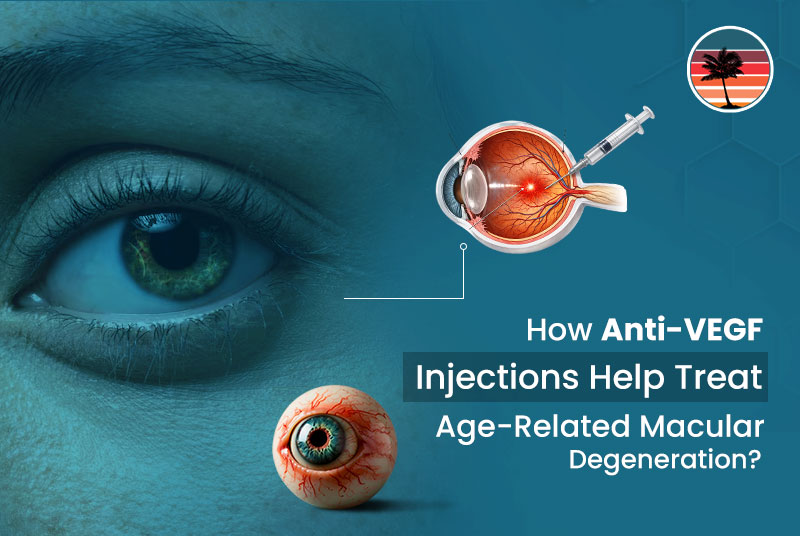
It happened slowly, didn’t it? You found words getting blurrier. Straight lines seemed to bend and wave. Then the words you dreaded-wet AMD-and with them a procedure called ‘an injection in the eye’.
This doesn’t sound good, but the fact is, the procedure doesn’t take any longer than your average lunch break, and the level of discomfort is surprisingly minimal. You’d be hard-pressed to disagree with the outcomes-90% of people retain their vision, and 30% recover lost vision.
Anti-VEGF injections are not a last-resort treatment for macular degeneration. They are the gold standard for the treatment of wet AMD worldwide, with two decades of evidence and millions of successful treatments to their name.
The first step towards walking into your appointment with excitement rather than trepidation is knowing what to expect and how it works. This guide will provide you with everything you need.
What Wet AMD Does to Your Vision?
The macula is where the retina is responsible for seeing sharp central images. In wet AMD, abnormal vessels grow beneath it, and they leak fluid and blood. That leakage scars the macula, destroying central vision – it can do this in just a few months.
The culprit behind this abnormal growth is a protein called VEGF (Vascular Endothelial Growth Factor). Block VEGF, and you block the damage.
How Anti-VEGF Injections Work?
The anti-VEGF drugs block VEGF. Without VEGF to stimulate leaky vessels to grow and form fluid, it begins to absorb, and your vision stabilizes and improves.
The doctor administers the drug directly into the vitreous – the jelly-like substance inside the back of your eye. This way, it is directly in the correct location to take effect.
It is well documented. Some 90 percent of patients retain their vision, and some 30 percent regain some lost vision.
Your Anti-VEGF Options in 2026
|
Drug |
Generic Name |
Approved |
Dosing Interval |
Mechanism |
|
Bevacizumab |
Off-label |
Monthly |
Blocks VEGF-A |
|
|
Ranibizumab |
2006 |
Monthly |
Blocks VEGF-A |
|
|
Aflibercept 2mg |
2011 |
Every 8 weeks |
Blocks VEGF-A, VEGF-B, PlGF |
|
|
Eylea HD |
Aflibercept 8mg |
2023 |
Every 12–16 weeks |
Higher dose, extended interval |
|
Faricimab |
2022 |
Every 12–16 weeks |
Blocks VEGF-A + Ang-2 |
Vabysmo and Eylea HD are the newest options on the market. They both help to extend the time between injections. Vabysmo works on two pathways in the body – VEGF-A and Angiopoietin-2 – so it may work well for people with ongoing leakage. Your RVAF retinal specialist will be able to use your imagery and previous treatment to determine if either of these drugs will be best for you.
What to Expect at your Appointment?
Expect your appointment to be approximately 15 to 30 minutes. The actual injection will take only seconds.
- Beforehand, you will be given eye drops to dilate and clean your eye, along with a numbing solution. You will not need to hold your eye open, as you will be given a lid speculum.
- During the procedure, you should not feel any pain; only a slight pressure. You may notice a brief shadow or some floaters for a short time.
- After the procedure, your eye may be slightly red and scratchy for a day or two, but most patients will resume their normal activities that day. Please call your physician if you experience severe pain, increased redness, or any changes in your vision after leaving the clinic.
How Often Will You Need Treatment?
First, you receive a loading period-an injection each month for 3 months. At that point, your physician initiates a treat-and-extend approach.
Under a treat-and-extend approach, your physician slowly increases the time between visits. Your appointments will be 6, then 8, 10, and, if needed, as long as 16 weeks apart, based on your OCT imaging at each appointment. We always aim for the lowest possible number of injections that keeps the macula dry.
Safety Profile
The safety profile of anti-VEGF therapy has been proven for 20 years. The majority of side effects are minor and transient:
- Mild and transient stinging or irritation of the eye
- Transient floaters or increased light sensitivity
- A small, benign subconjunctival hemorrhage (red patch on white of the eye), which resolves over two weeks.
Severe complications of anti-VEGF treatment are very infrequent. Infection of the eye, known as endophthalmitis, occurs in less than 1 in 1,000 injections, and retinal detachment occurs even less frequently. All injections at RVAF are given according to a very stringent, carefully established sterile protocol, the result of 54 years of retinal care.
The Cost of Waiting
Wet AMD doesn’t stop. Without treatment, the leaking vessels continue to scar your macula. These scars never go away. Without treatment, the majority of patients with Wet AMD will have lost their reading vision within one or two years. Early treatment is your biggest asset.
Your Vision Is Worth Protecting
AMD is aggressive, and what is damaged cannot be undone. Anti-VEGF injections for macular degeneration offer you the most effective medical tool for preventing further harm-but only if you catch it before the window closes.
Find out more about what happens to your vision with macular degeneration and what your treatment may involve – then take your next step to the specialist who will help guide you through it.
At Retina Vitreous Associates of Florida, you will have a fellowship-trained retina specialist with 54 years of experience in Tampa Bay and one of the nation’s top retinal clinical trials units. Our experts formulate an eye-specific, personalized plan-not an assembly-line solution.
Book your consultation at RVAF. Your retina specialist is ready. Your vision cannot wait.
Retina Vitreous Associates of Florida. 54 Years of Sight. A Lifetime of Care.