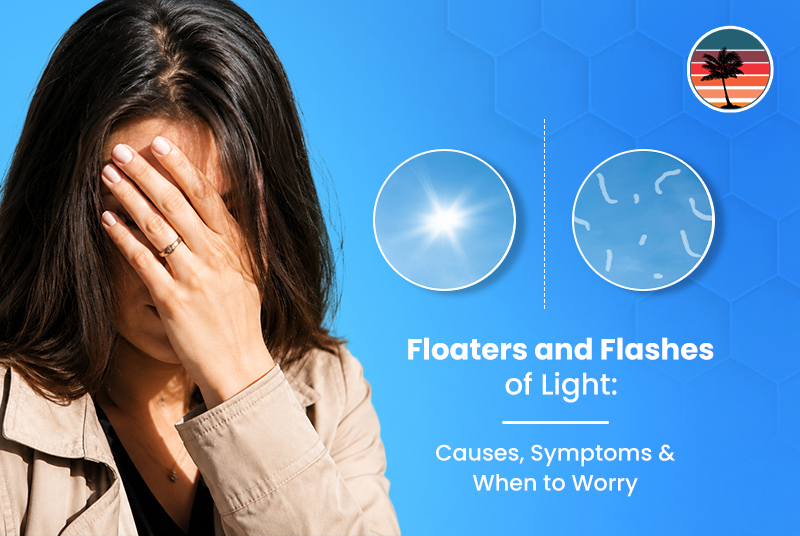
Are you starting to see new eye floaters and flashes of light and feeling concerned? Do you find yourself asking whether those specks in your vision are safe, why you are suddenly seeing sparks, or if there might be something seriously wrong with your retina? Although most floaters are harmless, a sudden appearance of them might indicate a tear or detached retina.
The challenge with the floaters and flashes you see is to determine when to keep a close eye on what is happening and when to take action.
In this blog, we will cover what floaters and flashes are what causes them, which symptoms you should pay close attention to, and how ophthalmologists examine your retina. Read on to find out which symptoms you should never ignore.
What Are Eye Floaters and Flashes of Light?
Making these symptoms less bewildering often comes down to having a basic understanding of what you are actually seeing. Floaters and flashes have separate visual origins, even though you might be seeing both due to changes in the vitreous.
Eye floaters are objects or shapes that appear to be floating in your line of vision. Depending on the type of floater, you may see something that resembles:
• Small dark dots
• Specks
• Squiggly lines
• Threads
• Rings
• Cobwebs
• Small shadows
Eye floaters develop from changes that happen in the vitreous humor, the gelatinous substance that occupies the space in the middle of the eye. Clusters and strands that can form within the vitreous will create shadows on the retina, and our brains perceive these shadows as floaters.
Most often, people are likely to see floaters if they are looking at a bright, unmoving background like a white wall, computer screen, or a clear blue sky.
An eye flash is different, though it may appear like flashes, sparks, or lightning. They tend to appear on the periphery of your field of vision, and they are typically caused when vitreous humor shifts and tugs at your retina.
What Do Eye Floaters Look Like?
While we all perceive and describe eye floaters in many ways, generally speaking, we are talking about small shapes that drift or float in our vision. Being aware of how people typically describe them will aid you when speaking to an eye doctor about them.
Typical descriptions:
• Black or gray dots
• Small circles
• Fine lines
• Long strands
• Spider web-like shapes
• Cloudy spots or shadows
Floaters usually move when you blink, and they can seem to dart away when you try to focus on them.
You might also see them more when it is bright outside, and they are easier to see when you are reading on a bright page.
Some slow changes and the addition of a few fixed floaters happen as we age. It is time to investigate further when you experience any noticeable changes in your floaters, whether they are in number, shape, or size.
What Do Flashes of Light Look Like?
Flashes of light often look like very short and quick things to ignore. They can look different depending on the type of flashes you have. Still, new flashes of light are critical to watch for,
To watch for, especially if other symptoms accompany them.
You may see:
• Lightning-like streaks
• Brief sparks
• Flickering lights
• Bright flashes at the edge of your vision
• Short bursts of light
As your vitreous changes over time, it can cause tugging on the retina. The retina can become stimulated, or mechanically irritated, producing a light-like flash.
You need to get new flashes checked out, because that same mechanism – vitreous tugging on the retina – can happen with a retinal tear.
What Causes Eye Floaters and Flashes of Light?
While many things can cause floaters and flashes, some are a natural result of the aging process. However, other issues may need immediate medical attention. The cause can take on more significance if the symptoms are new or the condition deteriorates rapidly.
1. Normal Aging
With age, the vitreous deteriorates and can become liquefied or clumpy, causing stringy lines that cast shadows on the retina – this leads to floaters. Posterior vitreous detachment is also a common side effect of aging.
2. Posterior Vitreous Detachment
If the vitreous peels away from the retina, that is a posterior vitreous detachment (PVD). PVDs are often a normal part of the aging process. Sometimes, PVDs cause sudden floaters and flashes of light. Fortunately, serious side effects of a PVD rarely occur. Still, in some instances, vitreous pulling may lead to a retinal tear.
3. Retinal Tear
You get a retinal tear when the vitreous pulls on the retina. If you start to see new floaters or flashes of light, these are signs to look out for. It is important to get your retina evaluated if you tear it since you can get fluid that leaks under the retina, which will lead to a detachment.
4. Retinal Detachment
An epiretinal membrane or tear in the retina can cause the retina to detach, or peel away from the back of your eye. If left untreated, vision loss is a serious possibility.
The signs can also be:
• A sudden increase in floaters
• Flashes of light
• A dark shadow
• A curtain-like area across your vision
• Sudden changes in vision
If you experience any of these symptoms, contact a medical professional in the nearest emergency eye clinic.
5. Eye Injury
Eye trauma can cause damage to the tissues inside the eye and raise your risk of retinal diseases. Always seek immediate evaluation for new floaters or flashes in your vision following a serious eye injury.
6. Nearsightedness
For the unaware, a person with a high level of myopia is prone to some issues in their retina. If you notice any of the above, especially if you have a high level of myopia, you should inform your eye doctor immediately.
7. Eye Inflammation
Uveitis and other eye inflammation can cause floaters, blurred vision, eye pain, and light sensitivity. Seek a comprehensive eye examination by an eye doctor for proper diagnosis and to treat the cause.
8. Bleeding Inside the Eye
Blood in the vitreous (the gel-like substance that fills your eye) may appear as new floaters, blurry patches, or blurry vision. Diabetes and other retinal diseases are common risk factors for this condition.
Seek immediate attention for sudden vision changes.
9. Migraine with Visual Aura
These new lights – wavy lines, dark spots, or dazzling, shimmering shapes – are often part of your migraines. However, just because you see shimmering spots does not automatically mean it is a migraine. An eye doctor should always check out new, unexplained shimmering lights in one or both eyes – particularly if you also have new eye floaters.
When Should You Worry About Eye Floaters and Flashes?
Most importantly, when did it begin, how fast did they develop, and did they come along with other vision changes? Most single floaters with no vision changes will not necessarily need to go in that day; however, if floaters came suddenly, it could signal an emergency.
See an eye specialist right away if you are experiencing any of the following symptoms:
• Increased number of new floaters.
• Sudden rise in the number of old floaters.
• New flashes of light.
• A combination of floaters and flashes.
• A shadow in your vision.
• A black curtain in front of you, obscuring some part of your vision.
• Reduced or loss of vision occurred suddenly.
• Peripheral vision was lost or significantly reduced recently.
• Floaters or flashes after a serious eye injury.
Those symptoms could point to a retinal detachment or retinal tear. Do not “wait it out”; get to an eye doctor who can perform a dilation eye exam and inspect your retina for a tear, detachment, or other complication.
Do Eye Floaters Go Away?
The good news: many floaters will get smaller and eventually go unnoticed. Your brain could adapt to them, or you might notice fewer of them due to fluid shifts in the vitreous.
Nonetheless, a sudden appearance of a new floater is not necessarily a big deal. See your ophthalmologist or optometrist to find out whether it is from vitreous changes or retinal tears.
Retina Vitreous Associates of Florida — Specialized care for the sight you depend on.
New floaters or light flashes can have a benign cause, but a sudden change could be a symptom of a retinal detachment or tear. The more you know about potential symptoms, the better you can intervene and prevent damage to your retina.
If you suddenly experience numerous floaters, new flashes or bursts of light, vision loss that looks like a dark shadow, like a curtain has been drawn over your eye, or a sudden loss of vision, do not delay. Seek immediate medical attention for your eyes.
For new or troublesome floaters and flashes, Retina Vitreous Associates of Florida can provide expert retinal care and treatment if you have issues with your retina or vitreous.
Do not delay – your eyes matter!
Frequently Asked Questions
1. Are eye floaters and flashes of light normal?
Some stable floaters are normal with aging. New, sudden floaters or flashes of light are more worrisome, as they may be evidence of a retinal tear or detachment, PVD, or other ocular disease.
2. What causes sudden eye floaters and flashes?
It often begins with sudden symptoms like floaters or flashes as your vitreous degenerates. However, some, like flashes and floaters due to retinal tearing or detachment, will require treatment.
3. When should I see an eye doctor for floaters?
Go to the eye doctor immediately for a new floater or flash in vision, and seek emergency care if you have a curtain, shadow, sudden sight loss, or large peripheral vision changes.
4. Can posterior vitreous detachment cause flashes?
Yes. If the PVD causes you to have flashes as the vitreous moves, the pulling could make a tear in your retina, which your eye doctor should check for, causing new floaters.
5. Can eye floaters mean retinal detachment?
Yes. You could have floaters, flashes, a dark spot, or even a shade or curtain across your vision when your retina is detached and requires medical attention immediately.