
You glance at a message on your phone, and it looks fuzzy. You wipe it off. No difference.
In the morning, the blur persists, and you find a small dark spot in the very middle of your field of vision, like looking through dirty glass that you can’t wipe away.
This is not eye strain, and rest will not help.
It might be a macular hole, and ignoring it could lead to blindness.
Macular holes develop silently. They’re painless and may be slow to appear, but they will slowly change how you see the objects in your path, making it difficult to read or recognize faces.
Is it permanent? Can it be fixed? What brought it on?
The guide explains the answer to these questions in simple terms so that you can take the appropriate steps to preserve your sight.
What Is the Macula?
Your eye has a light-sensitive layer on the back that is called the retina. In the center of the retina is a small area called the macula. This area is 5mm in diameter, so very small, and yet its role in your vision is the most important one.
The macula is where all that you see in front of you takes place – reading, face recognition, TV viewing, and driving. In the center of this area, a hole is created.
What Is a Macular Hole?
The macula hole is a hole through and through in your macula. It is not a tumor. It is not an infection. It is a physical hole in your macula, the central part of your retina.
Inside your eye, there is a clear fluid, like jelly, that is stuck to the retina. As your eye ages, the vitreous, or this jelly, will shrink down and peel away. Normally, this is an innocent process.
But in many people, the vitreous will tear at the macula. That tear develops into a macular hole.
What Causes a Macular Hole?
The most frequent cause is age-related traction of the vitreous. The vitreous shrinks with age and exerts a pulling effect on the macula. With time, the traction overcomes the thin center of the macula.
Age, however, is not the only cause of macular holes. Several other conditions are thought to provoke or influence the onset of a macular hole.
8 Key Causes of a Macular Hole
Rarely is there a single, specific cause to explain why you’d end up with a macular hole. In most cases, it is an effect of changes that occur, often unseen, in the eye over a period of months—or indeed years.
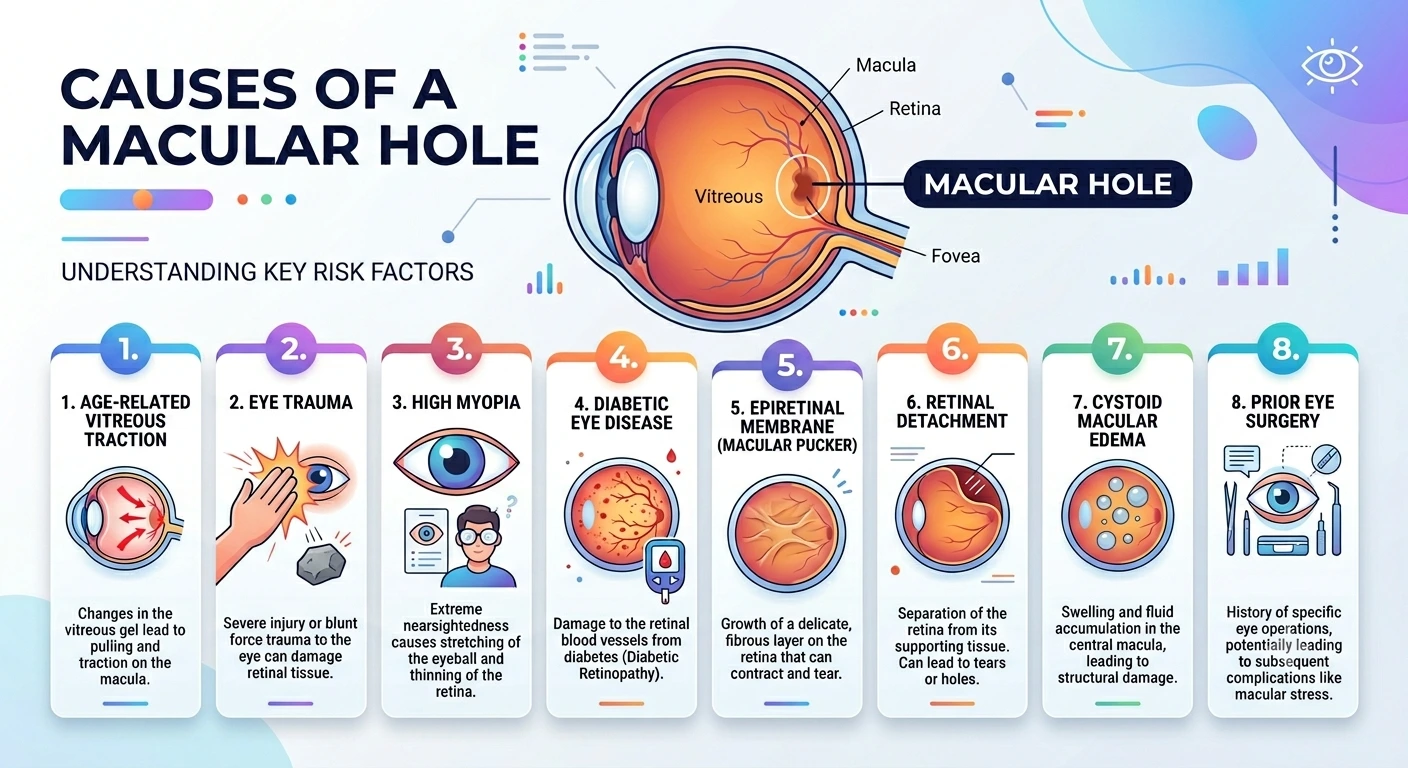
The eight causes are:
1. Age-Related Vitreous Traction
This is also the commonest cause. The vitreous humor inside the eye contracts as we get older. As it separates from the macula unevenly, traction develops on the retina at the center. It is sufficient to rupture the thin retinal tissue at this point. It predominantly affects people aged 60 or older.
2. Eye Trauma
A direct blow to the eye. This is typical of sporting injuries, trauma, accidents, falls, etc., and produces a shock wave through the eye that, even without any outward sign of damage, can injure the macula. Trauma-related macular holes can develop in quite young individuals.
3. High Myopia
A very myopic eyeball has been elongated. A long eyeball puts stress on the retina. The stretched retina is thin and fragile. In an eye with extreme myopia, there is ongoing traction on the macula, making a hole more likely to form in the absence of vitreal traction.
4. Diabetic Eye Disease
Diabetes can affect the blood vessels in your retina, which is called diabetic retinopathy. Fluid can then be leaked from these damaged blood vessels and collect under the macula. Swelling increases pressure on the macula. Over time, the macula can weaken, and holes can form.
5. Epiretinal Membrane (Macular Pucker)
Epiretinal membranes are a layer of fibrous scar tissue that forms on the surface of the macula. They develop and then contract. This traction is said to cause a pull and distortion of the retina, and, if too great, a hole can form.
6. Retinal Detachment
Retinal detachment occurs when the retina separates from the back wall of the eye and is an eye emergency. It can lead to a macular hole, either directly as a complication or indirectly in associated diseases. They share many risk factors and are usually treated together by a retina specialist.
7. Cystoid Macular Edema
A fluid-filled cavity inside the macula, often due to inflammation, surgical procedures, or vascular problems in the eye. As the cyst develops, it splits the macular tissue and eventually ruptures, leaving a hole.
8. Prior Eye Surgery
There is a minor but definite risk of macular hole formation after cataract surgery and other intraocular procedures. Factors that contribute to this condition include post-operative inflammation, post-operative fluctuation in intraocular pressure, and mechanical trauma from surgical instrumentation. Routine post-operative review can detect these changes.
Who Gets Macular Holes?
There is a variability in who is at higher risk. The most recognized risk factors are:
- Age (> 60)-this is the strongest risk factor.
- Sex (females are disproportionately affected compared to males).
- High myopia-those with severely poor vision have a higher risk.
- Diabetes or heart disease-these can affect the blood vessels of the retina.
- History of trauma to the eye, any history of blunt eye trauma.
- Prior macular hole in the other eye-this makes the other eye more susceptible.
- Prior eye surgery or eye inflammation can be a factor in postsurgical complications.
RVAF | Protecting the Vision That Matters Most
The most common cause for a macular hole is the age-related changes of your vitreous gel. Trauma, diabetes, and high myopia, however, have also been implicated in the development of macular holes.
A macular hole develops subtly and silently. By the time patients notice symptoms, the macular hole may already be well developed. This is the harsh reality.
The good news is that a macular hole is often treatable if detected early. The single correct decision can make all the difference.
Your central vision is a precious part of you. Don’t lose it while you can still preserve it.
Have you noticed a blurred area, a dark spot, or wavy/distorted lines? Don’t delay!
At RVAF, our retinal specialists utilize state-of-the-art OCT technology to detect macular holes at their earliest possible stage – and preserve your potential for full vision recovery.
Schedule your comprehensive eye exam today at rvaf.com
After all, clear vision is a privilege, not a luxury. It represents your quality of life.
Frequently Asked Questions
1. When should I see a retina specialist for a macular hole?
If you experience any blurring or distortion of central vision, or the presence of a shadow in your field of vision, then you need to seek immediate medical attention.
2. Can a macular hole cause blindness?
Although macular holes may not lead to complete blindness, they have a great impact on central vision and thus make activities such as reading and driving challenging.
3. How is a macular hole diagnosed?
A macular hole can be detected by an eye specialist through a thorough retinal examination along with various imaging techniques like Optical Coherence Tomography (OCT).
4. Can a macular hole heal on its own?
Some very early-stage macular holes can close on their own, but most cases of macular hole closure need surgery to prevent further vision impairment.