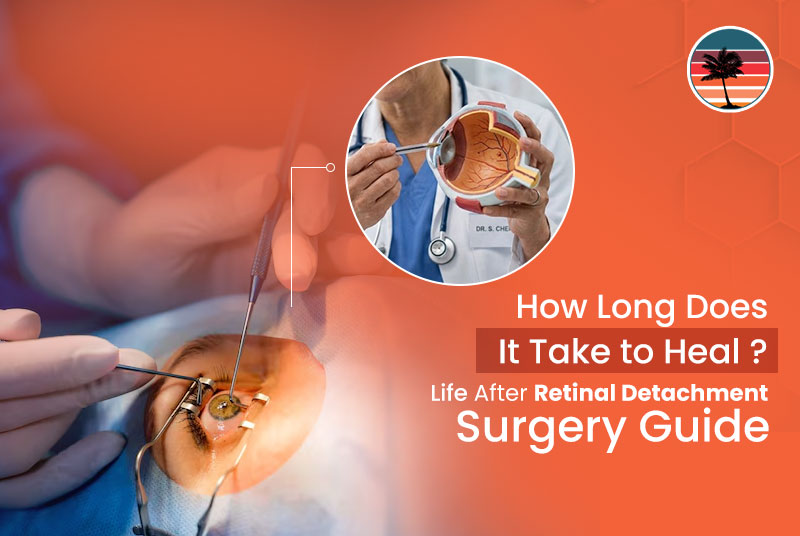
It had started so innocently one day: you felt the curtain move across your eye, or a swarm of floaters and light flashes came to an immediate and persistent rest on your field of vision. An emergency diagnosis followed, then an immediate surgery that could not wait any longer.
The surgery is complete now, and in some ways, the real challenge is only beginning.
Your vision is hazy. Your eye is tender. You are spending your first several days lying facedown, repeatedly asking, “Is this normal?” Am I recovering? Will I regain my vision?
Here’s the fact: most patients experience great recovery, and everything you are feeling right now is temporary. The real work of recovery, however, requires patience, persistence, and accurate information at every point in the process.
This guide provides you with just that, from your initial week in recovery to your six-month milestone marker when your sight finally stabilizes.
What Your Surgeon Did to Fix Your Retina?
The retina is a very fine sheet of tissue that covers the inside of the back of your eye. This sheet converts light into nerve signals for your brain to interpret. If it is detached, the retina loses its blood supply, and vision quickly fails; surgery becomes the only option.
There are three ways of repairing a detached retina:
- Pneumatic Retinopexy-A bubble of gas is inserted into your eye to push the retina back into position.
- Scleral Buckle-A flexible silicone band is tied around the outside of the eye to close the retinal tear.
- Vitrectomy-The vitreous gel is removed from the back of the eye and replaced by a bubble of gas or silicone oil. This will push the retina back into position.
Vitrectomy is the most commonly performed operation at present. Your RVAF surgeon will decide which operation best suits the type and location of your detachment.
What warning signs caused your diagnosis? Our guide to the signs of retinal detachment will help you recognize them and protect your sight.
Recovery Timeline: What to Expect Each Week
Recovery isn’t uniform for all people, and it’s affected by the type of surgery, your age, and how quickly treatment was commenced. This guide will give you a reasonable overall framework:
Week 1: Rest, Drops, and Positioning
It’s normal to feel pain, be light sensitive, and have blurred vision while your eye recovers from the immediate surgery.
If a gas bubble was used in surgery, you will probably need to spend the next few days with your head bowed forward and your face facing the floor. This holds the bubble against the repaired area of your retina; failure to do so can result in the surgery failing. You will be monitored to ensure your head is in the correct position and that you do not become lazy!
- Take all prescribed eye drops religiously.
- Wear the eye shield supplied for the first few days, particularly at night.
- Stay off screens as much as possible.
- Do not rub your eye.
Weeks 2-4: Signs of Progress Begin to Appear
The gas bubble begins to absorb during this time, and you will see an arc or a moving line at the periphery of your vision, which is simply the upper border of the bubble. This should resolve completely in 6-8 weeks, depending on which gas was used.
Your vision will still be a little wavy/distorted, but this means the retina is healing and is nothing to worry about.
- Desk jobs can begin, with your surgeon’s approval, from week 2 or 3.
- Do not do anything involving heavy lifting, bending over at the waist, or strenuous exercise.
- Do not fly: pressure changes in aircraft cabins can increase intraocular pressure and expand the gas bubble, causing damage.
- Attend all outpatient appointments; your surgeon needs to monitor the progress of retinal reattachment.
Weeks 4-8: The Eye Starts To Settle Down
The inflammation begins to settle, and the vision starts to sharpen for the vast majority of patients. Your retinal attachment should be confirmed in a dilated eye examination by your surgeon.
The final visual result will be slightly below preoperative levels. The retina heals more slowly than you might expect, and it takes some time for your brain to adapt.
- Walking and light exercise can resume.
- Driving is likely possible at the discretion of your ophthalmologist once your visual acuity is satisfactory.
- Don’t change your glasses or contact lens prescription; your refractive error is likely to be altering slightly over the coming months.
3-6 Months: Final Visual Outcome Achieved
Most people achieve their final visual acuity between three and six months after their operation. If there was macular detachment before surgery, recovery could take a year or longer.
If an intraocular oil tamponade was used, it is normally removed with a subsequent operation after several months.
Activities to Avoid After Surgery
Your surgeon will provide you with a customized list of activities to avoid. Many patients should avoid the following until their surgeon clears them to resume.
- Air Travel – Avoid any air travel until the gas bubble has been reabsorbed.
- Heavy Lifting or Straining – These increase intraocular pressure and can cause retinal reattachment.
- Contact Sports or Impact Sports – A direct blow to the eye, in particular near the site of the surgery, can cause damage.
- Swimming or Hot Tub – These increase the risk of infection while the wound is healing.
- Rubbing the Eye – This is very important and, even light rubbing, can disturb the retinal repair.
- Driving – This may not be allowed until your vision has returned to an acceptable level.
What Is Normal? What Is NOT Normal
Knowing when an expected discomfort is an emergency symptom will both give you some peace of mind and ensure your safety.
What is normal during recovery:
- Temporary blurred/hazy vision for several weeks.
- Brief light flashes and floaters in the early part of your recovery.
- Sensitivity to light.
- A constant moving image of the edge of your gas bubble.
- Minor redness and discomfort of the eye.
Immediately Notify Your RVAF Surgeon If You Experience:
- Sudden or progressively worsening vision loss.
- New shadow, curtain, or veil in your visual field.
- Severe pain in the eye that does not resolve with rest or OTC medication.
- Increased redness, swelling, or discharge from the eye.
- A fever after surgery.
These may represent a retinal re-detachment or infection and should not be delayed for a routine visit.
Will Your Vision Return to Normal?
The only crucial determining factor is whether the macula was attached or detached at the time of surgery.
If the macula was attached at the time of surgery, one should have a good chance for visual recovery. Retinal detachment repair is successful in over 90% of cases. For example, patients who are taken to the OR within 24 hours of macula detachment always have better vision than those who wait longer.
If the macula was already detached before surgery, there will likely be some degree of central visual loss even with an anatomically successful repair. Vision might improve for months; however, the final visual outcome takes time to be ascertained.
The Emotional Side of Recovery
Losing your vision, even temporarily, is incredibly unnerving. Feeling anxious, irritated, or even depressed during recovery is entirely appropriate.
You will not see your progress week to week and will need assistance with tasks you are used to performing yourself. Give yourself space to allow for that.
What actually works:
- Keeping My Appointments – Seeing physical proof of your healing on the scan brings reassurance.
- Peer Support – It is worthwhile to find online forums or active support groups established by retinal detachment patients.
- Speak to Staff – RVAF has sympathetic and understanding staff who can help you with more than just the surgery.
Recovering in Tampa Bay? RVAF Is Here.
Losing your vision doesn’t have to be something you face alone.
Retina Vitreous Associates of Florida is the largest retina practice in the Tampa Bay area. All surgeons are board-certified and fellowship-trained in vitreoretinal surgery. World-class eye care brought home with over 54 years of expertise and a nationally renowned retina clinical trial program.
Weeks into your recovery or just starting to detect the initial signs? Do not wait! The earlier the treatment, the better the outcome.
Your vision is worth protecting. Call RVAF today.
Schedule your appointment—Retina Vitreous Associates of Florida – Tampa Bay’s Retina Specialists for 54+ Years.