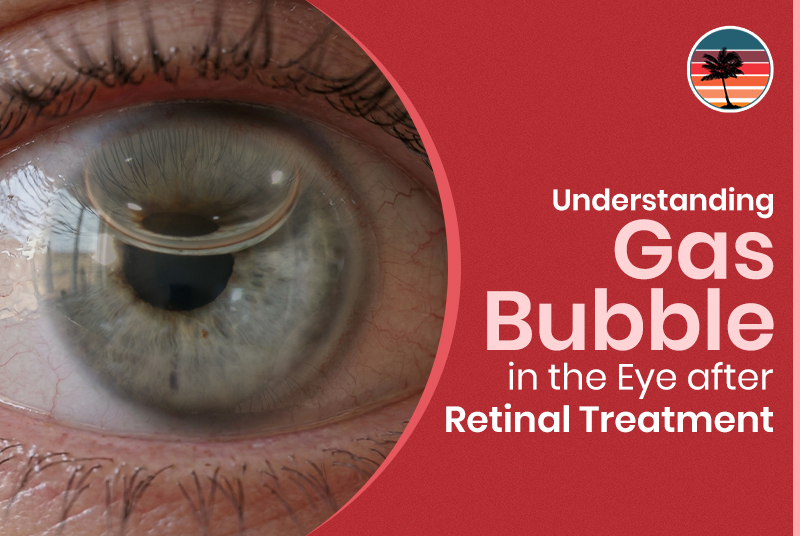
Your gas bubble plays an important role. It pushes your retina up to the back wall of your eye during healing. It acts as a tamponade (swelling or blocking) to prevent fluid from accumulating beneath the retina.
Since surface tension prevents fluid from interfering with the formation of the bond between the retina and the wall of your eye, the bubble acts as like a clamp to hold the retina in place during healing. Gradually, your eye will replace the bubble with its own fluid. Many patients ask, “When does the gas bubble in the eye finally go away?, The answer depends on the type of gas used and how your eye heals.
Conditions Requiring Gas Bubbles
In addition to use in retinal detachment, doctors also use gas bubbles for several other extreme retinal diseases:
- Retinal Detachment- The bubble keeps the retina in place during and promotes reattachment. It is by far the most popular reason for using a gas bubble.
- Macular Hole- The bubble helps close the hole by applying pressure from within. It allows the edges of the hole to come together and closes the macula.
- Retinal Tears- The bubble supports the tears, while laser or cryotherapy stabilizes the tears.
- Proliferative Diabetic Retinopathy Angiopathies- Advanced cases commonly need gas support after surgery.
Like a clamp that holds two pieces in contact while glue dries, the bubble holds the retina in place while it heals and if there is laser, while the laser is forming an adhesion.
Types of Gas Bubbles and Duration
Not all gas bubbles are equal—their type is selected based on the specific needs of the surgery.
1. Air Or Balanced Salt Solution
Life span- 5-7 days. Air bubbles are best used for small retinal tears or for simpler procedures. These bubbles have the shortest recovery period and allow for the quickest return of vision.
2. Sf6 (Sulfur Hexafluoride)
Life span- 10-14 days, up to 2-3 weeks. As the most commonly used gas, SF6 is best suited for moderate retinal detachments or for the treatment of macular holes. The bubble expands to 2 times the injected volume.
3. C3f8 Gas Bubble (Perfluoropropane)
Life span- 55-65 days (6-8 weeks). This is the longest-lasting option and is typically used for more complex detachments that require greater support. The bubble expands to 4 times the injection volume.
4. Silicone Oil (As An Alternative)
Life span- 2-6 months and longer. Provides long-term tamponade for very complex cases, but requires an additional operation to remove the oil.
Comparison Table
|
Gas Type |
Duration |
Expansion |
Best Used For |
|
Air |
5-7 days |
None |
Minor tears |
|
SF6 |
2-3 weeks |
2x volume |
Moderate detachments |
|
C3F8 |
6-8 weeks |
4x volume |
Complex detachments |
|
Silicone Oil |
Months |
None |
Severe cases |
What You’ll See: Stages of Gas Bubble in Eye
Knowing what’s normal helps you remain calm during recovery.
1. Initial Stage: Full Bubble (First Few Days)
Your vision seems completely blurred all the time. It’s like looking through water or heavy haze. Perception of light continues, but details are gone. It’s normal.
2. Middle Stage: The Horizontal Line Appears
A horizontal line appears as your bubble gets smaller. The line is a divider between your gas and the natural eye fluid. The line wiggles as you move your head. The line is gradually decreasing as your bubble shrinks. This is actually a positive indicator of healing.
3. Late Stage: Improving Vision
The bubble shrinks; the bubble fills less of your view. The layer below the bubble becomes more sharply defined from the bubble. Your vision over the line becomes clearer. Reading is easier. Faces become recognizable.
4. Final Stage: Complete Absorption
The bubble completely clears—your eye refills with natural aqueous humor. Vision gradually returns to the preoperative level or exceeds it. Several weeks may be required for some patients to achieve final visual acuity.
Imagine this as fog lifting from a valley floor. Slowly, the bottom of the valley appears.
Critical Positioning Requirements
How you position your head has the most significant impact on the outcome of the operation and your recovery.
Why Positioning Matters?
Gas naturally floats up to the highest point in the eye. You need to hold your head so the bubble lies over the treated area, or your retina will not heal properly. Improper positioning can lead to surgery failure.
Common Positioning Instructions
-
Face-Down Positioning (Most Common)
Used by doctors to treat macular holes and central retinal problems. Keep this position for up to 2 weeks. Floor, chin down, look at the floor. Sleep face down, or use special machinery.
-
Side-Lying Positions
Lying on the right side is effective for a tear on the right side of your retina. Lying on the left side is effective for a left-sided tear. Your doctor wants you to maintain a particular position, depending on where your eye is torn.
-
Duration and Compliance
Remain in your prescribed position for most days. Most physicians recommend 45-50 minutes per hour. Short breaks are fine for eating and elimination. Remember also about the nighttime positioning.
-
Positioning Equipment and Aids
Resting faces down comfortably. Face-opening cushions provide a comfortable resting position. Several pillows in the home will provide additional support. Equipment may be rented.
Establish a platform for entertainment on the floor—place mirrors to view television programs. Earphones and in-ear headphones enable audio entertainment.
Sticking to the instructions is essential for success. Short-term pain ends in long-term recovery.
Activity Restrictions and Safety Guidelines
Those who have a gas bubble in their eye will be exposed to the following whilst engaging in some activities:
Absolute Restrictions
1. No Air Travel
The more complicated answer is that you can’t travel while a gas bubble is there. As altitude increases, pressure decreases, and the gas expands. This can permanently damage your optic nerve. Wait until your doctor says all of the bubbles have absorbed.
2. No High Altitudes
Avoid mountain driving. Remain 1000 feet vertically lower. Consult your physician if you will be traveling to a different altitude.
3. No Nitrous Oxide Anesthesia
If you require dental or any other surgery, please inform all practitioners of your gas bubble. The gas may expand with exposure to nitrous oxide. This is a grave complication and may be fatal.
Daily Activity Modifications
Use a special face-down bed or rehab chair, along with special face-down cushions, to sleep. Take sponge baths or shower with help. Eat slowly and keep good posture. Take drinks out of a straw: no heavy lifting, laborious exercise, or sudden head movements.
Recovery Timeline and Follow-Up Care
Knowing what to expect will help you monitor your progress through recovery.
1. Week 1
Initial discomfort and distortion of vision. Adherence to strict positioning protocols is critical. The bubble is fully expanded. Visual acuity is drastically reduced.
2. Weeks 2-3 (SF6 Gas)
The horizon line becomes visible. Vision slowly clears over the horizon line. Most SF6 bubbles have dissolved by the end of Week 3.
3. Weeks 4-8 (C3F8 Gas)
The further gradual absorption continues. Your visual field widens as the bubbles narrow. You will be fully absorbed within 6-8 weeks.
Regular Follow-Up Appointments
First visit is 1-3 days after surgery. Weekly visits are maintained during the acute phase. Your doctor will assess retinal attachment and measure ocular pressure. Never miss any appointment-they are essential to recovery.
Life after the Gas Bubble
Once the bubble is fully absorbed, your recovery process advances.
Your vision may take weeks to months to stabilize. You can return to your normal activities as your doctor clears you, and air travel is permitted only after the bubble is fully absorbed. Your follow-up appointments will continue for months after the surgery.
Take care of your pre-existing conditions, such as diabetes and hypertension, and keep all your appointments. When patients follow the guidelines, success rates are high.
Why Choose RVAF for Retinal Surgery?
The gas bubble implanted in the eye is a temporary aid that usually lasts 5 days to 8 weeks, depending on the type of bubble used. It is imperative to follow all instructions regarding head positioning to achieve a positive outcome.
With patience, the healing process is usually successful, and patients typically achieve excellent outcomes.
It’s experience and expertise that count in advanced retinal surgery. At RVAF, you benefit from over 54 years of specialized retina surgery experience with thousands of successful vitrectomies and gas tamponades performed in the Tampa Bay region.
With multiple locations throughout the Tampa Bay region, you have easy access to the best care throughout your recovery process. If you’re suffering from retinal detachment symptoms or would like a second opinion, call RVAF today to schedule a consultation.
Frequently Asked Questions
1. Why is a gas bubble used after retinal surgery?
The gas bubble works just like a splint on the inside. The surface tension makes sure that the gas bubbles remain against the retina, healing any tear or hole and fixing the retina back to its proper position.
2. Will my vision be blurry while the gas bubble is in my eye?
Yes. During the period when there is a bubble, vision will be highly impaired, usually referred to as viewing things through water or thick fog. This is normal since vision will slowly become clearer as the bubble decreases and is replaced by natural fluids from your eye.
3. Can I fly or travel to high altitudes with a gas bubble in my eye?
Flying or traveling above about 1,000 feet is not safe until the bubble is completely absorbed because of increased air pressure in the high altitude, leading to the expansion of gas, thus increasing eye pressure and causing vision loss.
4. Can I drive with a gas bubble in my eye?
Driving is not advised until the bubble interferes with your vision so much that it affects your ability to see clearly or partially blocks your vision. The eye specialist will inform you when you are ready to drive.
5. What symptoms should I report after retinal surgery with a gas bubble?
Contact your surgeon immediately if you have increasing pain, sudden loss of vision or a curtain falling across your eyes, light flashes, increased floaters, or redness and discharge — all of which may indicate increasing eye pressure, infection, or retinal re-detachment.