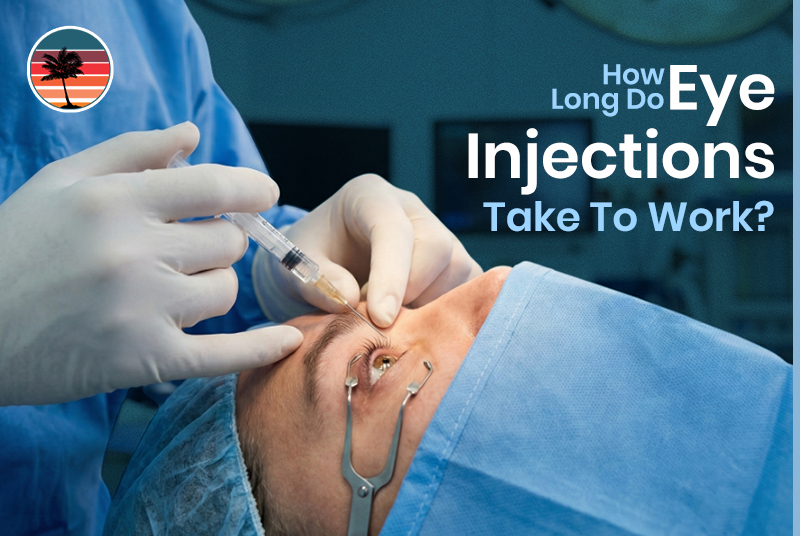
How long does it take for eye injections to work? The actual injection only takes 10-15 minutes. Most people will see improvements in their vision within 7-10 days, with the full effect typically reaching its maximum in 1-4 weeks.
The idea of an eye injection can be frightening. However, that all sinks in compared to knowing how long it actually takes. Over 14,500 procedures are performed every day, each taking under 15 minutes with no pain!
Understanding Eye Injections: What They Are
Let us first understand what occurs during an injection before examining the timetable. You are injected into the vitreous (the gel inside your eye). This is called an intravitreal injection, meaning the medication is delivered directly to the retina, bypassing the barriers that protect the eye from topical medications.
This treatment can be used for severe eye conditions, including wet age-related macular degeneration (AMD), diabetic retinopathy, diabetic macular edema, retinal vein occlusion, and macular edema.
You are given a different medication depending on your diagnosis. For example, Intravitreal anti-VEGF injections, such as Eylea, Lucentis, and Avastin, can stop abnormal blood vessel growth. Steroid injections and implants can reduce inflammation and edema (swelling).
Imagine your retina is the guardian of your vision. These injections deliver nutrients directly to the site of need.
How Long Does The Procedure Take?
The injections take much less time than most patients expect.
Allow 20-30 minutes in the office from arrival to departure. This time includes setup, the procedure, and a short observation period. Your first visit may take 2 to 4 hours, as it consists of a doctor visit and completing a consent packet. Follow-up injection appointments are much faster.
Procedure Breakdown
-
Preparation (5-10 minutes)
Your doctor puts ‘numbing drops’ in your eye. These will take a few minutes to work properly. A staff member cleans your eye very well with a solution called Betadine to prevent infection.
-
The Injection Itself (10-20 seconds)
A tiny speculum holds your eyelids apart. Your doctor then injects a small needle, approximately the same diameter as a hair, into your eye. The needle then advances through the white part of the eye and into the vitreous gel. The entire injection process takes only seconds.
You will experience a mild pressure-like sensation. Most people define it as pressure rather than discomfort.
-
Post-Procedure (2-5 minutes)
The doctor washes your eye out with saline. The team tests your vision by getting you to count fingers. You will be left alone for a few minutes while they observe you. You do not require an eye patch.
What you’ll Experience?
Immediately after the injection, your vision will be blurry. Bring someone to drive you home. Patients are always surprised at how quick and painless the treatment is. The fear is much less after you’ve done it once.
How Long Until You See Results?
Your healing process starts naturally after the injection. It can take its time.
-
Immediate Effects (First 24-48 Hours)
Improvement in swelling or hazy vision may be seen on the day of the injection. However, initially, visual acuity might be worse! Your vision may be hazy because the medication is temporarily causing it to appear cloudy. Your eye may be sore, and your vision may be hazy.
The most discomfort occurs on Day 1. Day 2: Soreness and haziness have improved to 60-70%. The puncture wound heals in 48 hours. Your results should not be assessed in the first two days.
-
Short-Term Results (1-2 Weeks)
Some patients report seeing some vision improvement within 1 to 2 weeks. The swelling in your retina begins to go down. Your vision is slowly improving. Often, this is when many patients realize that they can read better or see faces more clearly.
-
Intermediate Benefits (1-4 Weeks)
The most effective will be about 1-4 weeks after your injection. Your vision will have settled down and can improve.
This is as if plants start sprouting after a winter. There is a slow but steady change.
-
Long-Term Timeline (Months)
To receive full benefits, repeated treatments over an extended period are necessary. Most patients will experience some functional gains between 1 week and 3 months although some patients take 6-12 months to reach full healing. For some eye diseases, the mean visual gains at 12 months, as measured by the eye chart, are 10.6 letters.
This results in a mean gain of 16.8 letters at 12 months with additional injections following an initial series. Furthermore, 92% of patients in the Clinical trial experienced vision improvement or stabilization. There are , unfortunately, about 5 percent of patients who lose significant vision despite treatment.
Some patients have a mean of 52 injections in 10 years to manage the disease. Regular injections will maintain vision over time.
Factors That Affect Timeline
There are a lot of factors affecting how fast you will see the results:
- Severity of Condition–more severe means slower progress
- Type of Medication–precise timings of action differ for each drug
- Patient’s response–the healing process is different for each person
- Treatment Regularity–periodical injections provide a higher success rate
- Patient’s Health–effectiveness is highly affected by blood sugar levels and blood pressure
Treatment Schedules: What to Expect?
The injections are most effective if given at the correct intervals.
Initial Loading Phase
The initial 3 to 6 months of treatment require monthly injections. This loading phase quickly suppresses disease activity while helping establish the drug levels. Not doing injections during this critical phase compromises the therapy.
Maintenance Phase Options
1. Treat-and-Extend Approach
It gradually extends the interval between injections. If the retina remains stable, this interval is lengthened by 2 weeks. Many patients ultimately reach administration intervals of 8-12 weeks.
2. PRN (As Needed) Approach
Injections are only needed when fluid or bleeding occurs. You’ll need to attend more follow-up appointments. This is likely to increase the number of follow-up visits but reduce the number of injections required.
3. Fixed Dosing Schedule
Most patients respond well on a fixed schedule of 4-8 weeks. It gives a predictable routine.
Steroid Injection Schedules
Steroid dosing routines include:
- Standard steroids: 4-12 weekly
- Dexamethasone implants (Ozurdex): 4-6 monthly
- Fluocinolone implants (Iluvien): up to 36 monthly
Follow-Up Visits
Your doctor will see you again after each injection, typically 4 to 6 weeks (this may vary by doctor). At these visits, they will check your vision and eye pressure. You will have an OCT, which will show your retinal thickness and fluid levels. Based on your results, you will be prescribed the following injection schedule.
This is like caring for your garden in different seasons. Regular nurturing gives you healthy plants in return.
Medication-Specific Timelines
Some drugs take slightly longer to take effect than others.
1. Eylea (Aflibercept)
Eylea can show improvement within 7-10 days. The maximum response is observed at 1-4 weeks. The drug’s effect lasts 4-8 weeks. The loading dose for Eylea is 3 injections monthly. After recovery, patients can be reviewed every 8-12 weeks.
2. Lucentis (Ranibizumab)
Lucentis comparison to Eylea involves a similar timeline. It has an established profile and aligns with a significant body of prior research. You will begin with monthly injections, then transition to PRN or treat-and-extend profiles.
3. Avastin (Bevacizumab)
Avastin is as effective as other anti-VEGF agents. Avastin provides a less expensive alternative. Time-to-results is similar to that of Eylea and Lucentis. The majority of patients are on monthly to bi-monthly regimens.
4. Steroid Injections
The onset of action of steroids is slower than that of anti-VEGF agents. A period of weeks to months is often required for the maximum effect, but the agents remain active between injections. Retinal clinicians use steroids for specific indications, such as uveitis and certain forms of cystoid macular edema.
Precision Care for Your Precious Sight.
How long do eye injections take to work? It’s a simple procedure that takes 10-15 minutes. Results are observed as early as 7-10 days; however, peak visual gains typically occur at 1-4 weeks.
What appears frightening becomes common. Regular therapy maintains your sight for life. You are not alone on this path. Retina-Vitreous Associates of Florida walks you every step of the way.
Your sight is essential. Each dose shields God’s gift of vision through all phases of life. Connect with the RVAF team to learn more about eye injections today.