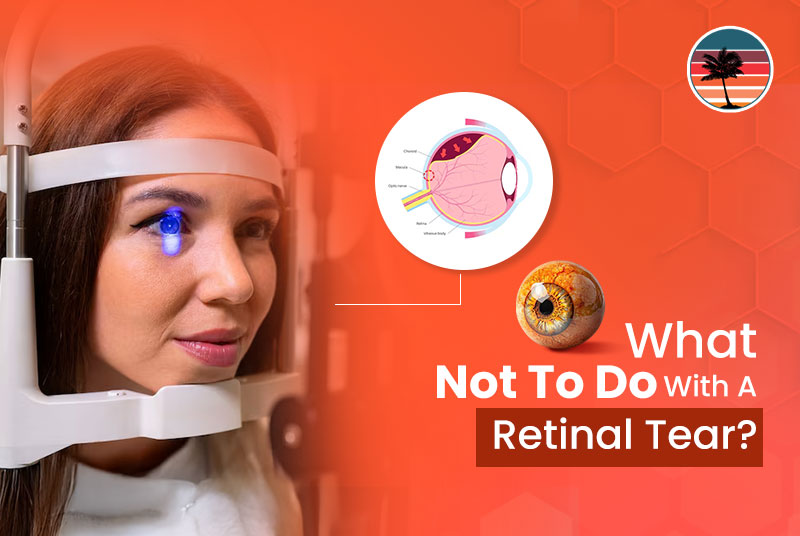
Retinal tears present a very short, yet critical, window of opportunity to act. Your actions or inactions within that time frame could preserve your sight.
Most people are completely unaware they have sustained a tear until the sudden onset of symptoms. And when symptoms do occur, many are in error. They wait it out. They rub their eyes. They hope it will go away. But what you don’t know may, in fact, be able to blind you.
If you’ve been searching for what not to do with a retinal tear or things to avoid with retinal detachment, you’ve come to the right place. In this guide, you will learn precisely what you must not do when dealing with a tear, both before and after treatment, before you seek medical care. It is important that you read it closely and then act promptly.
What Is a Retinal Tear?
The retina is a thin layer of tissue at the back of the eye that detects light and transmits visual signals to the brain, without which no sight is possible.
A tear in the retina occurs when the vitreous humor (the gel inside the eye) separates from the retina, leaving a rip. It is not identical to a detached retina. However, an unmanaged retinal tear can lead to retinal detachment and, consequently, permanent sight loss.
Watch for these warning signs right away:
- Sudden new floaters (tiny dots, lines, or cobwebs drifting in your field of vision).
- Flashes of light, particularly at the periphery (sides) of your vision.
- A dark curtain moves across your peripheral vision.
If you experience any of these phenomena, cease all activity and call your retina specialist immediately, as they signify a medical emergency. Discover the causes and effects of retinal tears and RVAF’s solution.
What Not to Do Before You See the Doctor?
Every minute before you see your doctor is precious. Everything you do or don’t do between the beginning of symptoms and your doctor’s attention can be critical in deciding between a quick, simple procedure and an unnecessary complication.
1. Do Not Apply Any Eye Drops Or Ointments
If your doctor didn’t prescribe these to you before your symptoms, avoid introducing anything new to the eye itself. Any substance might be an irritant or cover symptoms that your doctor needs to observe.
2. Do Not Try To Self-Treat
There is no cure for retinal tears, no home remedy. Cold compresses, vitamins, or OTC eye drops will not repair a retinal tear.
3. Do Not Wait And See
This is perhaps the most dangerous step. Retinal tears can lead to full detachment within hours or days. Horseshoe tears, the most common type, have a more than 50% risk of full detachment when left untreated; with prompt medical attention, which risk can be reduced to below 5%.
4. Do Not Drive Yourself To The Clinic
If your vision is distorted or blurry, you can be a danger to yourself and others on the road. If at all possible, have someone else drive you, or call for transport services if you are concerned about your driving.
What Not to Do After Treatment?
The majority of retinal tears are treated with laser photocoagulation or cryotherapy. Both methods cauterize the tear, reducing the risk of retinal detachment. Recovery takes 2 to 4 weeks for most patients. During the recovery period, rules are just as important as before treatment.
A. Exercise
1. Do Not Undertake Any Physical Exercise That Requires a lot of Motion
Heavier gym exercise, running, cycling, and high-intensity cardio will cause movement which could be a problem. Try to restrict recreational reading as well.
2. Do Not Lift Anything Heavy
Lifting compresses the internal aspects of the eye and places undue pressure upon the healing retina. If you have bleeding in your eye this could cause a rebleed. You will need to strictly adhere to your eye surgeon’s instructions regarding weight restrictions.
3. Do Not Bend Down Suddenly From The Waist
This type of movement causes a sudden buildup of pressure inside the eye. Bend from the knees to retrieve items if you must.
4. Do Not Participate In Any Contact Sports
Examples of contact sports include football, basketball, boxing, and racquetball, in which blows to the head or eyes can be sustained.
5. Do Not Engage In Any Sudden Jerky Head Movements
Sudden, jarring head motions will mechanically put pressure on the retina.
B. Daily Habits
1. Rub Or Press On The Eye
Do not rub or press on the eye, not even gently. Your eye is healing, and any touching at this point can disturb it.
2. Do Not Miss Follow-Up Appointments
New retinal tears may develop after the first. Most tears do not produce symptoms. Your RVAF surgeon will need to see you regularly to detect new tears.
Long-Term Habits to Avoid After Full Recovery
A healed retinal tear does not mean you are clear. You have an increased risk of another tear if you have already had one. It is important to take long-term precautions to ensure your eyesight remains healthy in the years ahead.
- Always wear protective eyewear during sports and whenever flying objects pose a risk to your vision.
- Do not ignore floaters or flashes even years after your initial procedure – Inform RVAF immediately.
- Do not disregard your overall health management – high blood pressure and diabetes can put unnecessary strain on the blood vessels supplying the retina.
- Do not underestimate the importance of your annual dilated eye examination – Doctors often find new retinal tears only during a dilated eye exam.
Why Tampa Bay Patients Trust RVAF?
For more than 54 years, Retina Vitreous Associates of Florida has been the biggest and most experienced retina specialty practice in Tampa Bay. Every surgeon on the RVAF team is board-certified and fellowship-trained in vitreoretinal surgery.
The practice also operates one of the most active clinical trial programs in the United States. It offers patients access to the newest technologies not available anywhere else.
When it comes to protecting your sight, you don’t want to be treated by a general practitioner; you want a retina specialist. At RVAF, we specialize in treating retinal tears. The Retina Vitreous Associates team and our specialized technology are here to protect your vision.
Don’t wait. If you suspect a retinal tear, contact the team at Retina Vitreous Associates today. We offer same-day appointments at our Tampa Bay locations.
Frequently Asked Questions
1. What should you avoid doing if you have a retinal tear?
Try to avoid heavy lifting, exercising with high impact, eye-rubbing, and delays in seeking treatment. Such actions can put pressure on the retina and cause it to become detached.
2. Can I exercise if I have a retinal tear?
Do not engage in vigorous exercises, jogging, and contact sports until you have been cleared by your retinal specialist. You can perform light exercises based on your situation.
3. What are the warning signs of a retinal tear?
These common symptoms are: the sudden appearance of floaters, flashes of light, blurred vision, and seeing a shadow or a curtain fall across your side vision.
4. Can delaying treatment make a retinal tear worse?
Yes. The delay in treatment may lead to fluid passing under the retina causing retinal detachment that may result in permanent blindness.