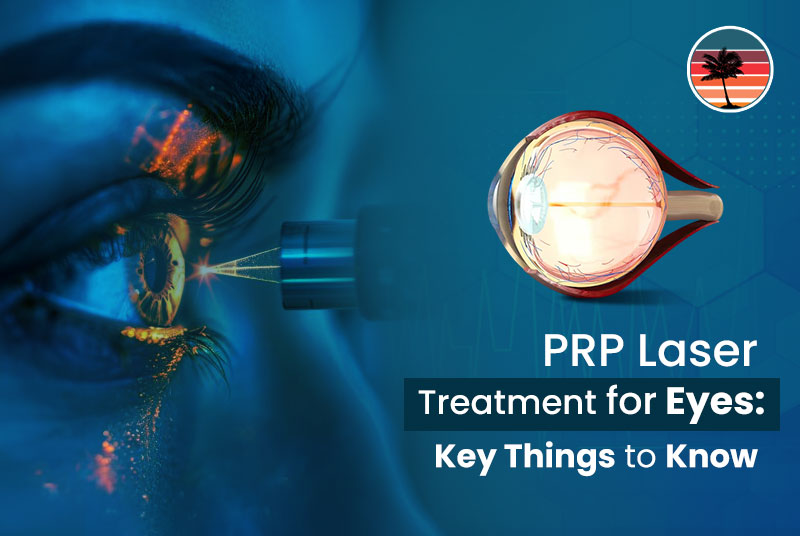
If your eye doctor just referred you for PRP laser, you’re likely asking yourself: What is PRP? Will it hurt? What will happen to me afterward? You are not alone, and we are here to help clarify your concerns. It is quite possible that you’ve never heard this term before, and you’re uncertain of what it will entail.
To start, it is important to address a common point of confusion in eye care. In ophthalmology, PRP does not mean Platelet Rich Plasma. Instead, Pan Retinal Photocoagulation is a type of laser surgery used by retinal physicians to save the sight of individuals with significant diabetic retinopathy.
What Is PRP Laser Treatment for Eyes?
PRP is a treatment of the peripheral, or outer, retina using a finely focused laser. Tiny burns on the retina because abnormal blood vessels to either slow or be destroyed.
These abnormal vessels are fragile; they bleed easily and pull on the retina, leading to visual impairment or blindness.
PRP is targeted to fix this specific issue. One of the immediate and important points to consider is that PRP can’t restore vision lost; it can only preserve the vision that has been retained.
Who Needs PRP Laser Treatment?
Retina specialists consider PRP for patients with any eye disease characterized by the formation of dangerous new blood vessels in the retina. Most often, the causes include:
- Proliferative diabetic retinopathy (PDR) is the most common cause of a PRP referral by eye doctors.
- Retinal vein occlusion with neovascularization (the growth of new, abnormal vessels).
- Sickle-cell retinopathy.
- Retinopathy of prematurity (ROP)-for premature infants.
If your eye doctor tells you that you have one of the conditions listed above, your retina specialist will discuss with you whether PRP laser treatment is appropriate for you.
How Does the Procedure Work?
There is understandable apprehension before your first treatment. It really helps to know what to expect.
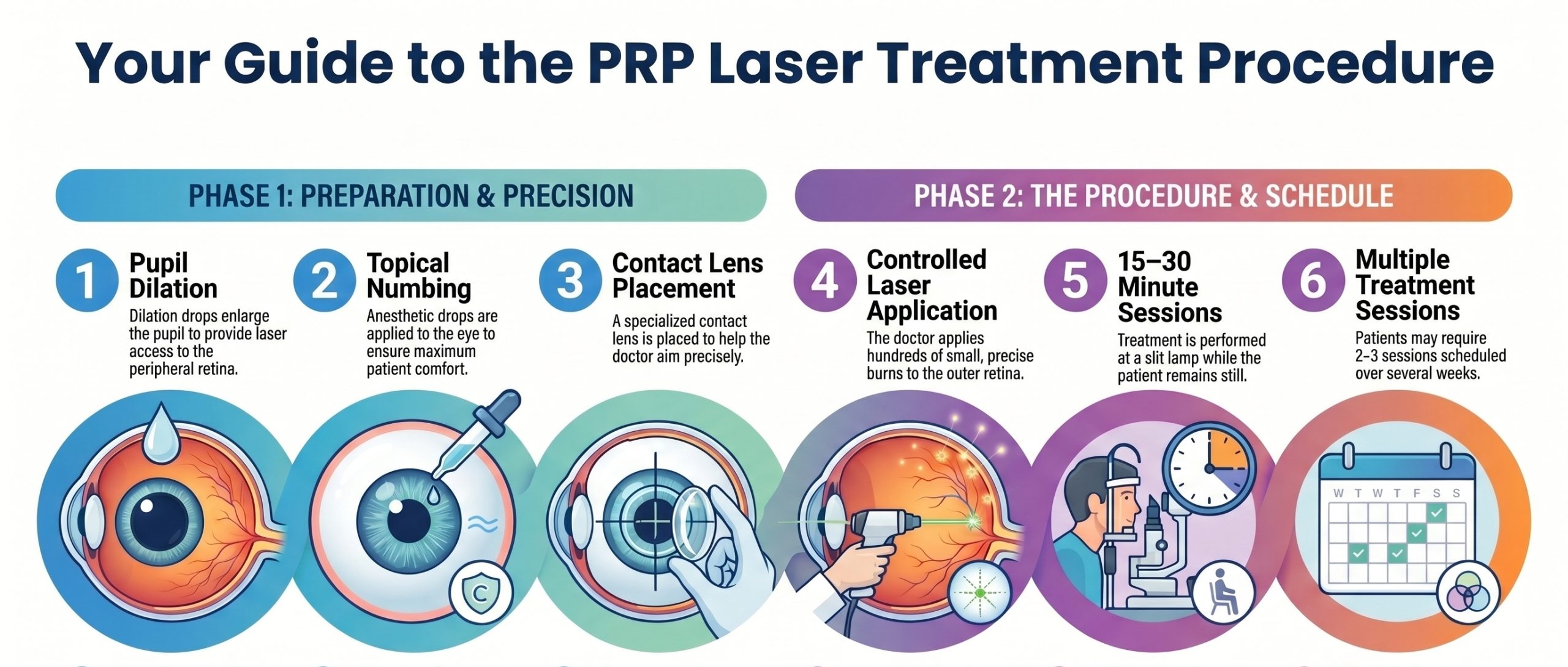
Here’s exactly what takes place during PRP laser treatment for the eyes:
- Dilation drops are instilled. This makes the pupil bigger so the laser can access the peripheral retina.
- Topical numbing drops are applied to ensure your treatment is as comfortable as possible.
- A special contact lens is placed on the eye, allowing your doctor to aim the laser precisely.
- Your doctor aims hundreds of small, controlled burns at the outer retina. While this sounds frightening, the burns are quite small and precisely aimed.
- Each treatment takes between 15 and 30 minutes. You will sit at a slit lamp and are asked to stay as still as possible and to follow the doctor’s and assistant’s instructions.
- More than one session may be required. Depending on the progression of the retinopathy, your retina specialist may want to repeat treatment 2 to 3 times over a few weeks.
What to Expect After PRP Laser Treatment?
The rest of the day is about rest. Here’s what most patients feel like after the laser:
- Blurry vision for several hours – this is expected and resolves shortly
- Light sensitivity – sunglasses are very helpful on your trip home
- Some aches or pressure around the eye that last up to 24 hours.
- You will need someone to drive you home – please do not drive yourself after the procedure.
Most patients can resume all normal, non-strenuous activities within 24 to 48 hours; strenuous activities and heavy lifting should be avoided for 1 to 2 days.
Your follow-up exam is essential-your retina specialist will need to evaluate whether the laser was successful and if you will require any further treatment. Be sure to attend this appointment.
It’s a bit of comfort to know that the laser only treats the peripheral part of your retina. Your central vision-the part of your vision that you need to read or to see faces-is not affected during the laser.
Does PRP Laser Treatment Have Side Effects?
PRP is a well-established and safe procedure. However, as with all treatments, PRP carries risks. Your retina specialist will discuss all of these risks with you before treatment.
Potential complications and side effects from PRP:
- Some decrease in night vision- the peripheral retina is responsible for some low-light vision.
- A slight reduction in peripheral (side) vision- this is acceptable because, in stopping dangerous vessel growth, you prevent total loss of vision.
- Rare complication of macular edema (swelling) – this will be checked at follow-up.
Consider this perspective: proliferative retinopathy that is left untreated has a higher risk of blindness than the complications associated with PRP treatment. It is recommended that you receive PRP treatment because the risks clearly outweigh the benefits in your specific circumstance.
PRP Laser vs. Anti-VEGF Injections — What Is the Difference?
Perhaps you’ve heard of anti-VEGF injections such as Eylea and Lucentis. They also help control the development of abnormal blood vessels, but in a different way.
|
PRP Laser Treatment |
Anti-VEGF Injections |
|
|
How it works |
Destroys peripheral retinal tissue, driving vessel growth |
Blocks the chemical signal that triggers vessel growth |
|
Number of treatments |
1–3 sessions typically |
Ongoing monthly or bi-monthly injections |
|
Best for |
Advanced proliferative retinopathy |
Earlier-stage disease or combined with PRP |
|
Effect on vision |
May reduce night/peripheral vision slightly |
Generally preserves more peripheral vision |
Why Choose RVAF for PRP Laser Treatment in Tampa Bay?
PRP laser treatment for the eyes is one of the retina specialists’ most effective ways to halt life-threatening retinal disease. It is safe, reliable, and used worldwide. Most importantly, it works- before vision-destroying changes are permanent. The sooner the retina specialist treats the condition, the more vision is retained.
Our doctors at Retina Vitreous Associates of Florida have a combined 54 years of retina experience in individual patient examinations. Each physician in the practice is retina fellowship-trained and dedicates their expertise solely to retina conditions. We serve Tampa Bay, St. Petersburg, Clearwater, and surrounding communities with a standard of care found only in Florida.
If you were referred to Retina Vitreous Associates of Florida for PRP laser, please do not wait. Even if your physician did not refer you and you know that you are a diabetic or have another retinal at-risk condition, now is the time to get evaluated by retina specialists. Our patient service representatives will schedule your appointment and verify your insurance in advance of your first appointment.
Please call us or request an appointment online today.
Frequently Asked Questions
1. Is PRP Laser Treatment For The Eyes Painful?
You will feel a little pressure or warmth with most of the treatment. We will use numbing drops to make it less painful. You may see small sparks of light when we fire a laser pulse.
2. How Many PRP Laser Sessions Do I Need?
Most patients require 1 to 3 treatment sessions; the exact number will depend on the amount of retina to be treated and your individual eye’s response. Your retina specialist will determine it.
3. Will PRP Laser Treatment Restore My Vision?
No. It prevents further damage to the sight, not the restoration of what is lost, which is why early intervention is so vital.
4. Is PRP Laser Treatment Safe?
Yes. PRP has been widely used by eye specialists worldwide for decades. The safety profile of PRP is very good when performed by experienced specialists.
5. How Long Does Recovery Take After PRP Laser Treatment?
About 24-48 hours for most people. It can take 1-2 days for your eyes to be less sensitive to light.
6. Does Insurance Cover PRP Laser Treatment For The Eyes?
Most standard health insurance policies cover PRP if recommended by a retina specialist. RVAF’s patient services staff can confirm coverage before your visit.