One evening, a woman sees flashing lights in the periphery of her vision. She blames it on fatigue and goes to sleep. Two days later, a dark shadow moves across her vision. By the time she reaches the doctor, the retina has detached entirely.
This story actually occurs more frequently than it should.
There is no pain with a detached retina, yet it is an eye emergency. Every hour of delay costs you vision — permanently. Understanding the symptoms of a detached retina can help protect your vision.
This article outlines the early warning signs of a detached retina, the most common patient groups at risk, and what you should do.
What Is a Detached Retina?
Your retina is a thin sheet of tissue located at the back of the eye. It works like the film at the back of a camera. Light strikes the retina, and images and vision signals are transmitted to the brain.
When the retina pulls away from its position, it loses the blood supply it needs to function. Imagine wallpaper peeling from a wall; when the paper comes away, the picture disappears with it.
A detached retina left untreated will cause permanent blindness.
There are three forms of retinal detachment:
- Rhegmatogenous – This is the most frequent kind of detachment, and occurs when the retina is torn or has a hole in it, and fluid begins to leak underneath.
- Tractional – Scar tissue pulls the retina away from its underlying layer, and is often seen in diabetic patients.
- Exudative – In this form, fluid leaks underneath the retina and lifts it away. There are no breaks or tears in the retina.
All three forms of the condition are serious. All three require immediate medical attention.
Common Symptoms of Detached Retina
These signs and symptoms can develop very quickly. Do not dismiss them.
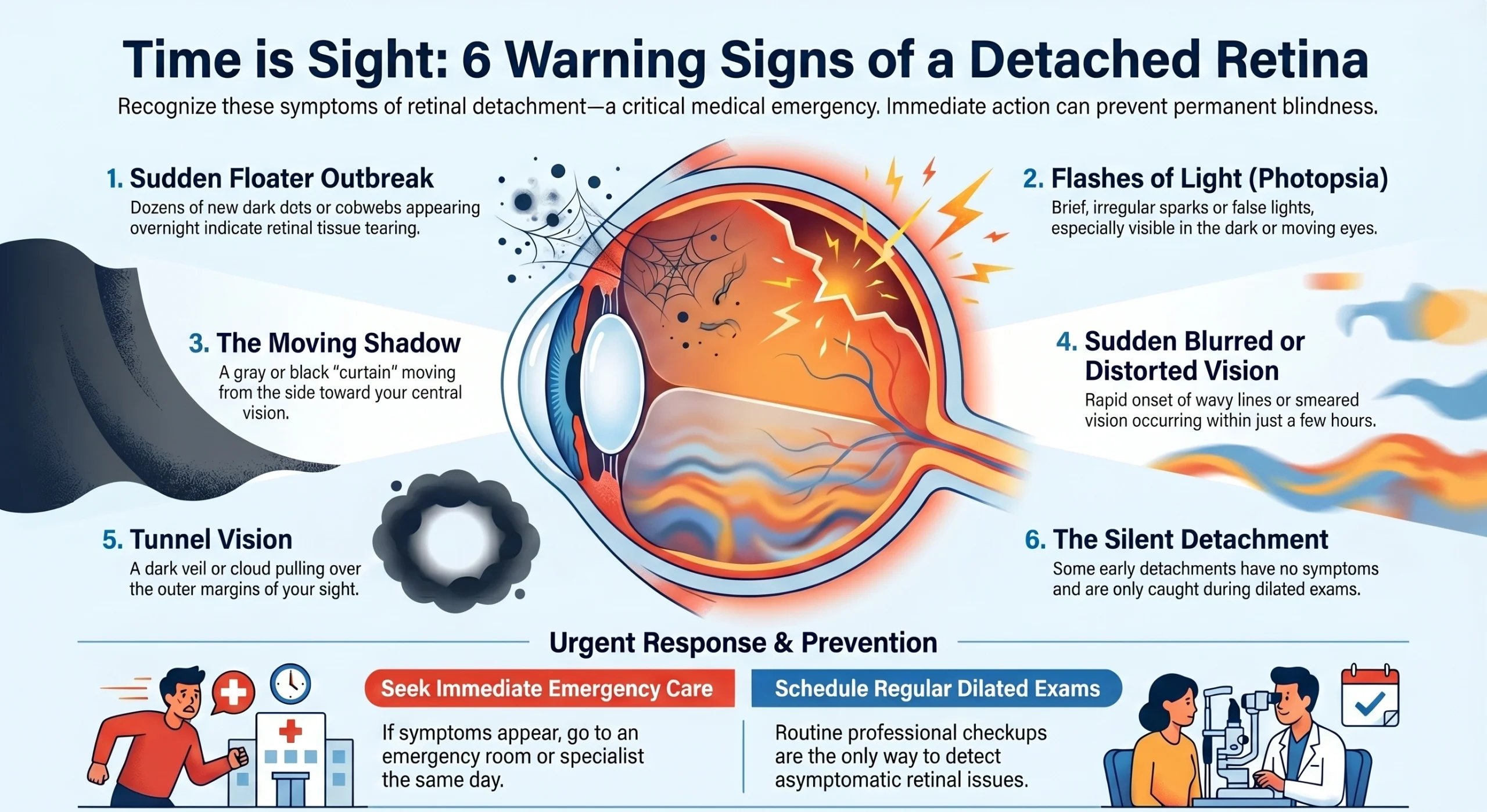
Symptoms of retinal detachment include a rapid onset of more floaters and flashes of light, a curtain or shadow obscuring vision, distorted or blurred vision, and a loss of side (peripheral) vision. Below is a description of each sign:
1. Sudden Increase in Floaters
Floaters are small dots, threads, cobwebs, or wormlike shapes that move through your line of vision. Many people have one or two floaters from time to time, and it’s normal.
An abundance of floaters, however, is not. It’s a serious warning sign.
When the retina rips, particles of retinal tissue or vitreous gel get dislodged. They cast shadows on the retina, appearing as dark, clustered floaters. You go from having one or two to dozens of floaters overnight – don’t wait!
2. Flashes of Light (Photopsia)
Seeing brief, irregular sparks of light – often in your peripheral vision – is an early warning sign of a detached retina.
The vitreous gel is tugging at the retina, causing it to send faulty signals to the brain and producing these ‘photopsia’ – false lights you see. You’ll tend to notice them more when it’s dark or when your eyes are moving rapidly. Since they occur early, before full detachment, they are your earliest window for seeking treatment.
Do not sit around waiting to see if the sparks resolve. Call your retina specialist on the same day.
3. A Dark Curtain or Shadow across Your Vision
This is typically the most alarming and clear sign of a detached retina. Patients often report seeing a gray or black curtain or shadow entering their vision from any direction — often from the side — and moving inward toward the center.
Suppose you do notice a shadow like this- stop. Do not wait until morning. Go to your closest emergency room immediately. Part of your retina is already separated.
4. Blurred or Distorted Vision
Blurry vision or visual distortion that seems to come on suddenly is also an urgent sign. You may notice that normally straight lines appear wavy or bent. Other objects may seem smeared or indistinct.
This occurs because your retina has become detached, so it is not possible to send clear signals to your brain. Unlike blurriness caused by gradual aging or refractive errors, blurriness caused by retinal detachment occurs very quickly, possibly within just hours. Any sudden, unexplained blurring in vision should be considered an emergency.
5. Loss of Peripheral (Side) Vision
This condition usually begins at the outer margins of your retina, which is why your peripheral vision will likely be lost first.
People describe this as seeing through a tunnel, like a dark veil or cloud being pulled over your vision, or as “tunnel vision.” Loss of vision at the margins is usually apparent.
If detachment involves the macula (the center portion of your retina, which allows for focused vision), the damage may not be reversible. Loss of central vision is usually a poor prognostic sign.
6. No Symptoms at All (Silent Detachment)
This tends to surprise people as well. Many very small, early retinal detachments are completely asymptomatic.
Doctors only detect them during a dilated eye exam. This is one of the most convincing arguments to schedule regular exams- particularly if you are a member of a higher-risk population.
Does a Detached Retina Hurt?
No. Retinal detachment is entirely pain-free.
The retina is insensitive to pain. You will feel nothing at all – not even as the vision deteriorates. That is exactly why many people leave it too long. The fact that it doesn’t hurt is why you must not ignore it.
Who Is Most at Risk?
Anyone could suffer from a detached retina. However, certain groups are at a greater risk than others:
- Adults over 50, though younger patients with high myopia or prior cataract surgery are also at elevated risk.
- Those who are highly myopic
- Diabetic patients or those with diabetic retinopathy.
- Those who have undergone cataract surgery.
- Anyone who has had a retinal tear or retinal detachment in either eye before.
- Family history of retinal detachment
- Those who have had eye trauma or blunt trauma to the eye.
How RVAF Diagnoses and Treats a Detached Retina?
Symptoms of retinal detachment happen quickly. Your reaction must be quicker.
Do not delay. Do not “wait and see” if the flashes or floaters will subside on their own. Your retina’s health is time-sensitive.
RVAF is the largest, most experienced retina practice in Tampa Bay. Our board-certified, fellowship-trained specialists are available to examine you – urgently if necessary.
Contact RVAF today by phone or schedule your appointment online. Your sight begins with what you do right now.
Frequently Asked Questions
1. Can A Detached Retina Heal On Its Own?
No. A retinal detachment will not resolve on its own; it will only get worse. Untreated, blindness is the permanent result.
2. How Fast Does Retinal Detachment Progress?
It can happen in minutes to days. Recovery from a detached macula will be very difficult once the separation has occurred. You need to act within the same day the symptoms present themselves.
3. Can Both Eyes Get Retinal Detachment?
Yes, if one eye detaches, your other eye is at higher risk too. The doctors will be paying very close attention to both of your eyes.
4. What Does A Detached Retina Feel Like?
No pain. You may experience visual disturbances (floaters, flashing lights, shadows), but no physical pain.
5. Can Retinal Detachment Be Prevented?
Sometimes you can’t stop it. Dilated eye exams once a year can detect tears before they progress to retinal detachment. Patients at risk of retinal detachment should see a retina specialist annually.
6. Is Retinal Detachment Surgery Successful?
Yes. If treatment is undertaken promptly, the success rate is excellent. The rate of vision recovery varies according to the duration of detachment and the macula involved.