Your eye hurts. It looks red. It can’t stand light. You go see a doctor and hear “uveitis” for the first time, and you ask only one thing: How long will this last?
Some patients recover in a few weeks, some in years. Some lose their sight forever, not because it’s impossible to treat uveitis, but because they delayed the proper treatment, or stopped prematurely. How long it lasts depends on three factors: the type of uveitis, the underlying cause, and the timeliness of proper treatment.
Uveitis-inflammation of the uvea (the middle of the eye, including the iris, ciliary body, and choroid)-is responsible for 15 percent of legal blindness in developed countries. A full understanding of its extent is the first step toward safeguarding your sight. Here, we explore the remaining information you need to know.
Acute vs. Chronic: The Line That Changes Everything
The first question your doctor asks is whether your uveitis is acute or chronic. Both will have different effects on the treatment regimen and on the outlook.
- Acute uveitis begins suddenly and lasts less than 6 weeks; it usually fully resolves with treatment. The majority of patients have only one bout and never have any other uveitic episodes.
- Chronic uveitis lasts longer than 6 weeks. There is no defined time frame; you continuously manage it through flares and abatement.
- Recurrent uveitis is an intermediate form in which it resolves each time, only to recur.
Each episode can be weeks or months long, often triggered by stress or systemic illness.
How Long Does Each Type of Uveitis Last?
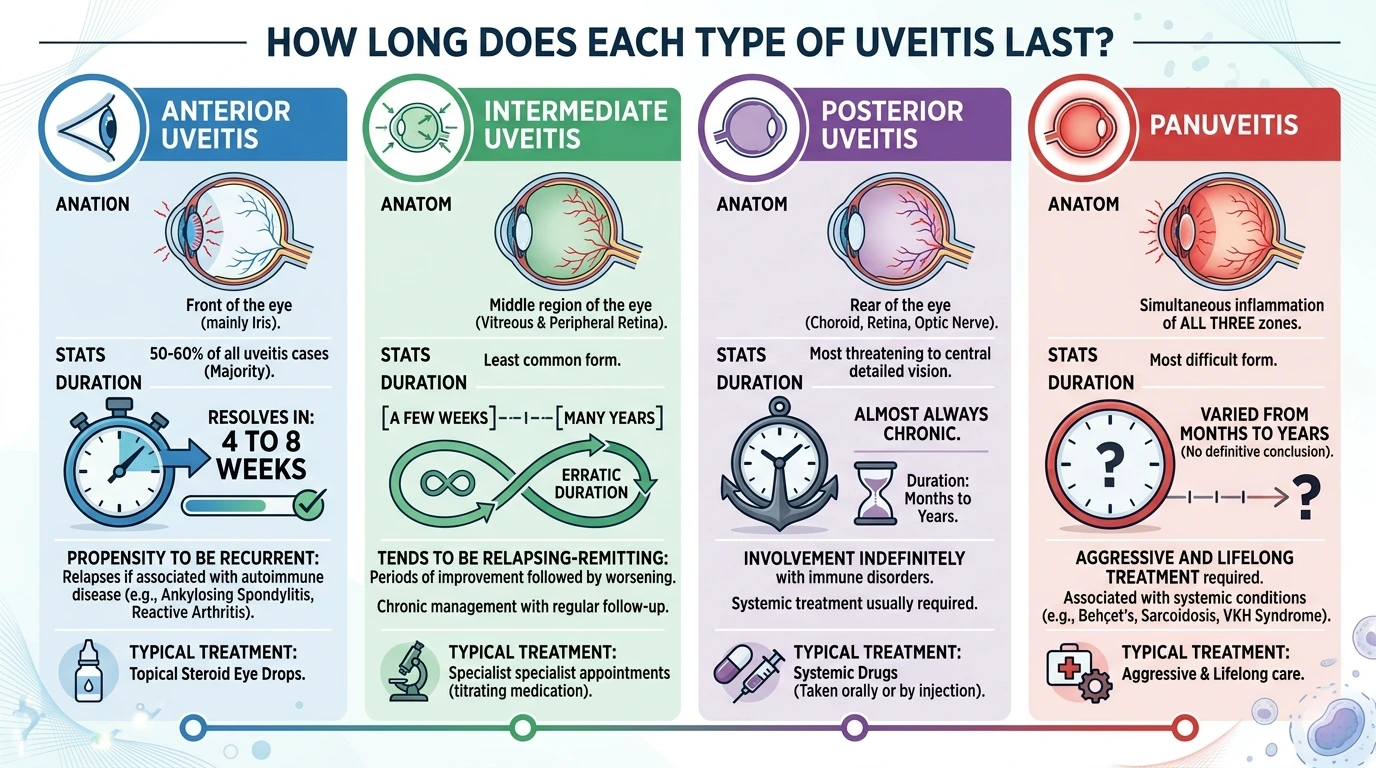
The type of uveitis you have depends on which part of the eye is damaged, and directly influences the length of the condition.
1. Anterior Uveitis
Anterior uveitis: inflammation in the front of the eye, mainly affecting the iris. It accounts for the majority (50-60%) of uveitis cases and usually resolves within 4 to 8 weeks with steroid eye drops.
Anterior uveitis has a propensity to be recurrent, if caused by an associated autoimmune disease (like ankylosing spondylitis, reactive arthritis), each relapse gives it a “new lease of life”.
2. Intermediate Uveitis
Intermediate uveitis occurs in the vitreous and peripheral retina, the middle region of the eye. It is the least common form and one of the most erratic.
Duration varies from a few weeks to many years. It tends to be relapsing-remitting, with periods of improvement followed by episodes of worsening. The majority of individuals with intermediate uveitis will manage the disease for many years with regular follow-up at specialist appointments, titrating medication accordingly.
3. Posterior Uveitis
Posterior uveitis refers to the part of the eye in the rear – the choroid, retina, and optic nerve. It’s the most threatening to vision because it affects the structures most responsible for central, detailed vision.
These forms are almost always chronic. An inflammation could be there for months to years, and usually requires systemic treatment-drugs taken orally or by injection-rather than merely topical treatment (drops). Certain infections, such as toxoplasmosis, may resolve with treatment. But, immune disorders can involve posterior uveitis indefinitely.
4. Panuveitis
Panuveitis is simultaneous inflammation of all three zones of the uvea. It is the most difficult and the most difficult to treat.
The disease’s duration varies from months to years, with no definitive conclusion. Most cases of panuveitis are associated with underlying systemic conditions, most notably Behçet’s, sarcoidosis, and VKH syndrome. Treatment is aggressive and lifelong.
Why Treatment Does Not Set a Timeline?
Almost everyone expects a stop date when they begin treatment. It doesn’t work that way. Treatment suppresses inflammation but does not resolve the underlying cause of the illness. The immune system eventually stops the disease, but no one knows when that is.
Your doctor manages treatment based on inflammation levels, not by a schedule. Corticosteroid eye drops work rapidly and generally continue for weeks in the case of anterior uveitis. Injectable steroids last months in the case of intermediate and posterior uveitis.
Systemic corticosteroids and immunomodulators are indicated in chronic uveitis to suppress inflammation. Stopping treatment too early is one of the most common reasons for recurrence. So listen to your physician’s instructions for tapers, even when you feel well.
How does the cause shape the Duration?
The underlying cause of your uveitis will largely determine the expected course and potential for recurrence.
Autoimmune conditions such as rheumatoid arthritis, lupus, sarcoidosis, and Crohn’s disease are generally associated with chronic, recurring uveitis. The condition is controlled, not cured. Ocular inflammation follows systemic disease when it is active.
Infectious causes of uveitis, such as toxoplasmosis, herpes simplex, or syphilis, can be self-limiting or amenable to successful treatment with antimicrobial therapy. Nonetheless, late diagnosis is associated with permanent damage.
Almost half of all cases of uveitis remain idiopathic. There is no underlying cause to treat in these patients. Therefore, the duration of inflammation and potential for recurrence cannot be predicted.
Symptoms That Signal Active Inflammation
Understanding what active uveitis feels and looks like enables you to identify flare-ups promptly. Shortened episodes of uveitis are characteristic of earlier intervention.
Eye pain and discomfort, as well as increased eye pressure, are the most prominent symptoms, and iris inflammation with blurry/cloudy vision and photophobia are closely associated. Floaters and a smaller or irregularly shaped pupil may also indicate active uveitis.
An urgent referral is necessary the same day if you experience sudden vision loss, significant eye pain, or halos around lights.
Complications That Develop When Uveitis Goes Uncontrolled
Untreated uveitis is not static; it can trigger a cascading process that may persist long after the inflammation resolves.
The most common complications include cataracts, which form progressively faster with both inflammation and steroid use. Also, glaucoma results from increased intraocular pressure due to either of these mechanisms, leading to subsequent damage to the optic nerve.
Macular edema, which causes visual loss from fluid accumulation in the macula. In more serious situations, retinal detachment or even direct optic nerve damage may arise from chronic inflammation.
The duration of uncontrolled inflammation increases the likelihood of developing each of these sequelae. Also, it underscores the critical importance of immediate, aggressive management.
When to See a Specialist?
Contact an ophthalmologist at the first sign of uveitis symptoms-don’t wait to see if it improves on its own. The standard of care for eye pain with redness and light sensitivity includes a same- or next-day appointment.
Don’t go to your general practitioner for eye pain-go straight to the eye doctor. You’ll likely need to be referred to a uveitis specialist or a uveitis clinic if you have a difficult, long-term, or treatment-resistant case.
A rheumatologist will be brought in if it’s determined you likely have an autoimmune cause of your condition. An infectious disease specialist will consult if a specific infection is diagnosed or suspected.
Retina Vitreous Associates of Florida — Protecting the Vision That Matters Most.
How long can uveitis last? Four weeks to several years, depending on the type, cause, and the speed at which you seek treatment. Anterior uveitis will often clear in weeks; panuveitis and posterior uveitis can develop into chronic conditions requiring ongoing management.
The element you can control is your behavior; each day of unmanaged inflammation puts your vision at risk. Find the appropriate specialist early, be consistent with treatment, and never discontinue therapy without direction.
Your vision is worth waiting for.
Retina Vitreous Associates of Florida has specialist physicians who have diagnosed and treated complicated uveitis cases daily and developed treatment plans specific to your eyes, not an averaged-out textbook recommendation.