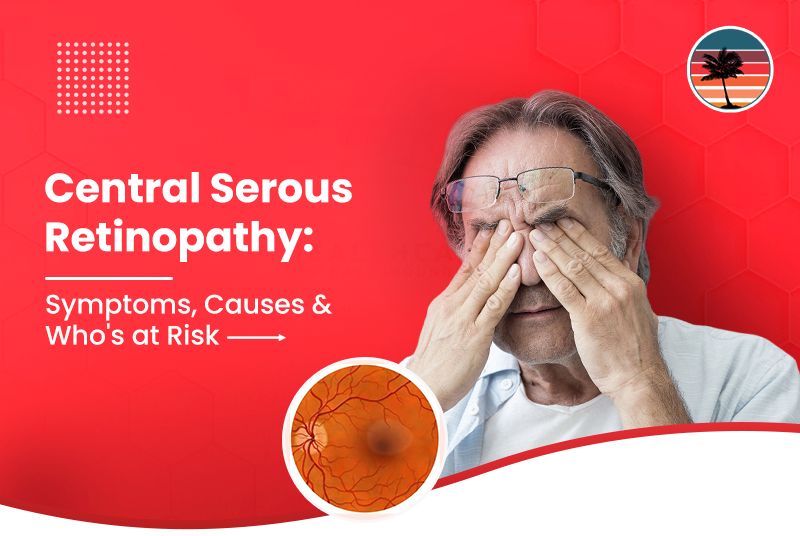
One day your vision is normal. The next, a gray smudge sits in the middle of everything you look at. Straight lines bend. Faces look slightly off. It’s unsettling, and Google searches at 2 a.m. rarely calm the nerves.
That smudge has a name: central serous retinopathy (CSR). It’s more common than you think, and in most cases, it’s treatable. But knowing why it happens, and whether you’re at risk, changes how you handle it. Stick with this guide. By the end, you’ll know exactly what to watch for and when to call a specialist.
Key Facts About CSR
Before we go deep, here’s the short version you can act on right now.
• CSR affects the macula, the part of your retina that gives you sharp central vision.
• It usually strikes one eye, though it can affect both.
• Stress, steroid use, and being male raise your risk.
• Most cases heal on their own within two to six months.
• Chronic or repeat cases need treatment to prevent lasting vision loss.
What Is Central Serous Retinopathy?
To understand why CSR causes its symptoms, it helps to know what’s happening inside your eye.
Your retina sits at the back of your eye. It turns light into signals your brain reads as images. Below the retina sits a layer of blood vessels called the choroid.
In CSR, fluid leaks from the choroid through the retinal pigment epithelium (RPE), a thin layer that normally keeps fluid out.
This fluid collects under the macula. The macula controls your central, detailed vision — the part you use to read, drive, and recognize faces. When fluid pools there, it slightly lifts the retina. This lift blurs and distorts what you see.
Doctors count CSR among the more common retinal conditions in adults under 55. It’s rarely blinding, but it can disrupt daily life and, in chronic cases, cause permanent damage.
For a full breakdown of diagnosis and treatment paths, see our complete guide to CSR.
Symptoms of Central Serous Retinopathy
Now that you know what’s happening under the surface, here’s what it actually feels like day-to-day.
CSR symptoms usually show up in one eye and develop over a few days. Watch for:
• Blurry central vision: Objects in the middle of your view look out of focus.
• A gray or dark spot: This spot sits right in your central field of vision.
• Distorted or bent lines: Straight edges, like door frames or text lines, look wavy.
• Dim or dull vision: Colors and light look weaker than normal.
• Objects that look smaller or farther away: Doctors call this micropsia.
• Washed-out colors: White surfaces may look dull, gray, or slightly brown.
Some people notice no symptoms at all. This happens when the fluid sits away from the macula. You may only find out you have CSR during a routine eye exam.
Warning Signs That Need Urgent Care
Symptoms alone don’t tell you how urgent the situation is. These signs do.
Call an eye doctor right away if you notice:
• Sudden, severe vision loss
• A rapidly growing dark spot
• Vision changes that don’t improve after a few days
• A curtain-like shadow across your sight
These signs can point to CSR or another serious retina problem. Only a dilated eye exam can tell the difference.
What Causes Central Serous Retinopathy?
Symptoms tell you something is wrong. The next question is why it’s happening in the first place.
Doctors don’t fully understand what triggers CSR. Research points to a few clear drivers.
Stress and Cortisol
Stress ranks as a leading trigger. When you’re under pressure, your body releases cortisol. This hormone can weaken blood vessels and cause fluid to leak. People with high stress and poor coping skills face a higher risk.
Steroid Medications
Corticosteroids are strongly linked to CSR. These drugs come in many forms:
• Oral tablets, such as prednisone
• Nasal sprays
• Skin creams
• Inhalers for asthma
• Joint injections
If you use steroids and notice vision changes, tell your doctor. Don’t stop the medicine on your own. Ask about a safe way to taper or switch.
Other Contributing Factors
Stress and steroids aren’t the only culprits. A few other health factors raise your risk of fluid leakage:
• High blood pressure
• Sleep apnea
• Pregnancy
• Use of PDE-5 inhibitor drugs, such as Viagra or Cialis
• Autoimmune disease treatments
Who’s at Risk for CSR?
Causes explain the mechanism. Risk factors explain who’s most likely to experience it.
CSR doesn’t strike everyone equally. Certain groups face a much higher chance of developing it.
• Men: Men develop CSR far more often than women, by as much as a 10-to-1 ratio in some studies.
• Adults aged 30 to 55: Most cases start in this age range. The average age of onset falls in the mid-30s.
• People with type A personalities: Competitive, time-driven people show higher rates of CSR.
• Steroid users: Any form of corticosteroid use raises your risk.
• People under chronic stress: High stress and weak coping strategies increase your odds.
• People with sleep apnea or high blood pressure: Both conditions strain your blood vessels.
• Pregnant women: Hormone shifts during pregnancy can trigger CSR.
If you fall into one or more of these groups, ask your eye doctor about regular screening. Early detection makes treatment easier and protects your vision.
How Do Doctors Diagnose CSR?
Recognizing your risk is step one. Getting a confirmed diagnosis is step two, and it starts with a simple exam.
An eye doctor starts with a dilated eye exam. This lets them view your retina directly. If they suspect CSR, they’ll likely order imaging tests:
• Optical coherence tomography (OCT): This scan creates a cross-section image of your retina. It shows the exact fluid location and depth.
• Fundus fluorescein angiography (FFA): A doctor injects dye into your arm and photographs it as it moves through your retina’s blood vessels. This reveals the leak point.
• Indocyanine green angiography (ICGA): This test highlights the choroid layer beneath your retina.
These tests confirm CSR and rule out other retinal diseases with similar symptoms, such as wet age-related macular degeneration.
Treatment Options for CSR
Once your diagnosis is confirmed, the next question is naturally: what happens now?
Most acute CSR cases need no treatment. Your doctor will likely recommend a wait-and-watch approach for the first three months. During this time:
• Fluid often reabsorbs on its own.
• Vision usually returns to normal or close to normal.
• Your doctor will review any steroid use and adjust it if safe to do so.
If fluid persists past three months, or if CSR keeps coming back, your doctor may suggest active treatment:
• Laser photocoagulation: A focused laser seals the leak point in the RPE.
• Photodynamic therapy (PDT): A light-activated drug targets abnormal blood vessels in the choroid.
• Anti-VEGF injections: Used in select cases with related blood vessel changes.
Your treatment plan depends on how long you’ve had symptoms, where the leak sits, and how much it affects your vision. Learn more about which treatment fits your case in our central serous retinopathy resource.
Outlook and Prognosis
Treatment matters, but so does what comes after. Here’s what recovery typically looks like.
Most people with a first CSR episode recover fully within two to six months. Vision often returns to normal, though some people notice minor changes in contrast or color even after the fluid clears.
Chronic or repeat cases carry more risk. Repeated fluid buildup can thin the RPE over time. This thinning can cause lasting blurred vision or reduced contrast sensitivity. That’s why doctors recommend follow-up exams even after your symptoms improve.
Retina Vitreous Associates of Florida — Focused on your vision. Committed to your future.
A gray spot in your central vision isn’t something to brush off, and it isn’t something you have to figure out alone.
Blurry vision, bent lines, and a dim central spot are your body’s early warning system. If stress, steroid use, or being male already puts you at higher risk, don’t wait for symptoms to worsen. A same-week exam and OCT scan can confirm CSR and rule out more serious conditions.
At Retina Vitreous Associates of Florida, we focus on protecting your central vision. Schedule a retina exam today and see clearly, sooner.
Frequently Asked Questions:
1. Is central serous retinopathy serious?
Most CSR cases are mild and resolve without treatment within a few months. However, repeat or chronic episodes can permanently reduce central vision clarity. Any sudden change in vision warrants a same-week eye exam to rule out more serious retinal conditions.
2. Can CSR go away on its own?
Yes, most first-time CSR cases clear within two to six months without treatment. Doctors still recommend an eye exam to confirm the diagnosis and an OCT scan a few months later to verify the fluid has fully resolved.
3. What causes central serous retinopathy?
CSR is caused by fluid leaking from the choroid into the space under the retina. The exact trigger is unknown, but stress, corticosteroid use, high blood pressure, sleep apnea, and pregnancy are the most strongly linked risk factors.
4. Who is most at risk for CSR?
Men between ages 30 and 55 face the highest risk, especially those under chronic stress or using corticosteroids. Type A personalities, people with sleep apnea, high blood pressure, and pregnant women also show elevated rates of CSR.
5. Does stress cause central serous retinopathy?
Stress is one of the strongest known triggers of CSR. It raises cortisol levels, which weaken choroidal blood vessels and increase fluid leakage. People with poor stress-coping skills show a measurably higher risk of developing CSR.
6. Can central serous retinopathy cause permanent blindness?
Complete blindness from CSR is rare. However, chronic or recurring episodes can thin the retinal pigment epithelium over time, causing lasting blur, dimness, or reduced contrast in central vision, especially without proper monitoring and care.