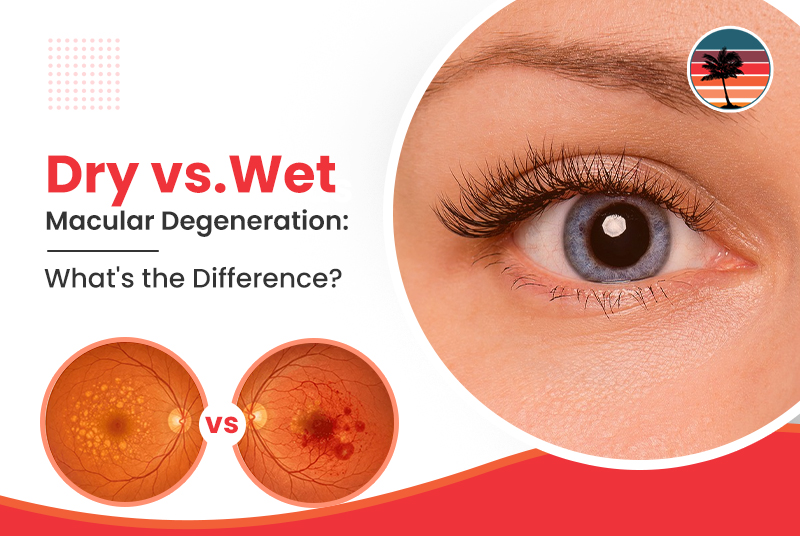
Your doctor just said “macular degeneration,” and now you’re staring at your phone trying to figure out how worried to be. Here is the honest answer: it depends entirely on which word comes next—dry or wet.
One version moves slowly, sometimes over years. The other can take your central vision in days. Same disease name, two completely different timelines, and mixing them up is the one mistake that costs people their sight.
This guide untangles the two for good: what causes each one, how they are connected, and what happens at your next appointment. Stick with it. By the end, you will know exactly what to ask your doctor.
Quick Answer
Dry macular degeneration is the slow thinning of your macula, marked by yellow protein deposits called drusen. At advanced stages, it can cause geographic atrophy, where patches of retinal cells waste away. Wet macular degeneration occurs when abnormal blood vessels leak fluid under your retina.
Dry AMD is more common and progresses slowly. Wet AMD is rarer, more aggressive, and almost always develops from existing dry AMD.
Key Takeaways
• Dry AMD is slow tissue thinning that can lead to geographic atrophy; wet AMD is fast blood vessel leakage.
• Dry AMD makes up about 90% of cases; wet AMD causes most severe vision loss.
• Wet AMD almost always develops from existing dry AMD.
• Doctors monitor dry AMD and can treat late-stage geographic atrophy with specialized therapies; they treat wet AMD with regular eye injections.
• Sudden wavy lines or a blank spot in your vision require same-day care.
Dry vs. Wet AMD: At a Glance
Skip the paragraphs for a second. Here is the entire comparison in one table:
|
Feature |
Dry AMD |
Wet AMD |
|
Cause |
Thinning and breakdown of the macula (leading to Geographic Atrophy in late stages) |
Abnormal blood vessels leaking fluid under the retina |
|
Also called |
Non-neovascular AMD |
Neovascular AMD |
|
Prevalence |
About 90% of AMD cases |
About 10% of AMD cases |
|
Progression |
Slow, over years |
Fast, sometimes within days |
|
Vision loss share |
Causes gradual central vision loss (can become severe with Geographic Atrophy) |
Responsible for most severe AMD-related blindness |
|
Cure available |
No cure; managed with lifestyle, vitamins, and specialized therapies for late-stage GA |
No cure; managed with ongoing eye injections |
|
Main treatment |
Lifestyle changes, AREDS2 vitamins, and complement inhibitors or light therapy for Geographic Atrophy |
Anti-VEGF injections, sometimes laser |
What Actually Causes the Difference?
The table tells you what happens. This section tells you why.
Your macula is the center of your retina and controls sharp, detailed vision. In dry AMD, the tissue layers of your macula slowly thin and stop working properly. Yellow deposits called drusen build up underneath. Over time, this thinning can progress to geographic atrophy (GA), where patches of retinal cells die off permanently.
In wet AMD, your body tries to compensate for retinal damage by growing new blood vessels. However, these new vessels are fragile and leak blood and fluid under your retina, causing fast, serious damage.
This is the core distinction: dry AMD is tissue breaking down and wasting away, while wet AMD is blood vessels breaking through and leaking.
Dry AMD: Symptoms by Stage
Dry AMD is a progressive disease. It rarely announces itself all at once, which is why it often goes unnoticed for so long.
• Early stage: You likely notice nothing. Your doctor sees small drusen during a dilated eye exam.
• Intermediate stage: You may notice mild blurring or trouble seeing in low light. Some people still feel no symptoms.
• Late stage (Geographic Atrophy): Straight lines start looking wavy, and you may see blank or blurry spots in your central vision. At this advanced stage, dry AMD causes geographic atrophy. Patches of cells in your macula die off, leaving permanent central blind spots. At this point, dry AMD symptoms start to look a lot like wet AMD.
Wet AMD: Symptoms and Warning Signs
Wet AMD does not have quiet stages. It shows up loud, and it demands immediate attention.
Wet AMD symptoms often appear suddenly. Straight lines, like door frames or window blinds, look bent or wavy. You may notice a dark or blank spot in the center of your vision. Colors can look faded, and central vision can blur or drop within days. Unlike dry AMD, wet AMD rarely has a quiet early stage.
If you develop wet AMD, you will usually notice visual changes quickly.
Can Dry AMD Turn Into Wet AMD?
This one question explains why doctors keep asking you to come back, even when nothing feels different.
Yes, and it is common. About 10% to 15% of people with dry AMD go on to develop wet AMD. Wet AMD doesn’t appear on its own; it almost always develops from existing dry AMD. That is why doctors recommend regular eye exams, even when your dry AMD feels stable. Catching the shift to wet
AMD early gives treatment the best chance to protect your vision.
How Doctors Diagnose Each Type?
Your symptoms offer a clue, not a diagnosis. Confirming the exact type takes a closer look at your retina.
Your eye doctor starts with a dilated eye exam to check for drusen, pigment changes, and geographic atrophy. If they suspect wet AMD or advanced dry
AMD, they will order diagnostic imaging:
• Optical Coherence Tomography (OCT): This safe scan captures high-resolution cross-sections of your retina, showing retinal thinning, geographic atrophy lesions, or fluid buildup.
• Fluorescein Angiography: Your doctor injects a special dye to highlight leaking blood vessels and confirm wet AMD.
These tests confirm your exact type and show how far the condition has progressed.
Treatment: What’s Different
Same disease name, but from here, the two treatment paths look completely different.
• Dry AMD treatment: There is no cure for dry AMD. For early and intermediate stages, your doctor may recommend AREDS2 vitamins, a diet rich in leafy greens, and quitting smoking to slow progression. If dry AMD advances to geographic atrophy, modern FDA-approved complement inhibitor injections or non-invasive light therapies can help slow down retinal cell loss. Regular monitoring watches for any shift toward wet AMD.
• Wet AMD treatment: There is also no cure, but there is active treatment. Doctors give anti-VEGF injections directly into your eye, often monthly, to stop abnormal blood vessels from growing and leaking. Laser therapy is used less often for specific cases.
Which Type Is Worse?
If you are deciding which version to worry about, wet AMD causes the fastest damage, but neither is harmless.
Wet AMD is considered more urgent. It accounts for only about 10% of AMD cases, but it causes the majority of severe, rapid AMD-related vision loss. Dry AMD is more common and usually progresses slowly. However, late-stage dry AMD with geographic atrophy can also cause severe central vision loss over time. Neither type should be ignored.
When to See a Doctor Immediately?
Most of this guide explains your diagnosis. This section focuses on when to act urgently.
See an eye doctor right away if straight lines suddenly look wavy, if you notice a new blank or dark spot in your central vision, or if your vision blurs quickly in one eye. These are classic signs of wet AMD or advancing geographic atrophy, and fast treatment gives you the best chance of protecting your sight.
Schedule Your Consultation with Retina Vitreous Associates of Florida
You now know more about dry and wet AMD than most people do at diagnosis. What you still don’t know is which type you have, and that is not something to guess.
Retina Vitreous Associates of Florida has diagnosed and treated both forms of AMD for Tampa Bay patients since 1971. Our board-certified, fellowship-trained retina specialists use advanced imaging to confirm your exact condition and build a personalized treatment plan.
Your next appointment could change your visual outlook entirely. Visit our scheduling portal now to request an appointment with specialists who manage AMD every day.
Frequently Asked Questions (FAQs)
1. What is the main difference between dry and wet macular degeneration?
Dry AMD is the gradual thinning of your macula with drusen buildup underneath it, which can lead to geographic atrophy. Wet AMD involves abnormal blood vessels leaking fluid under your retina. Dry AMD progresses slowly over years, while wet AMD can cause serious vision loss within days.
2. Can dry macular degeneration turn into wet AMD?
Yes. About 10% to 15% of people with dry AMD eventually develop wet AMD. Wet AMD rarely appears on its own, which is why regular dilated eye exams matter even when dry AMD symptoms feel stable.
3. What is geographic atrophy in dry AMD?
Geographic atrophy (GA) is the advanced stage of dry macular degeneration. In GA, patches of light-sensitive cells in the macula waste away and die, causing permanent blank or dark spots in your central vision.
4. Which is worse, dry or wet macular degeneration?
Wet AMD is generally more urgent because it progresses rapidly and causes the most severe AMD-related vision loss. However, advanced dry AMD with geographic atrophy can also cause severe central vision loss over time.
5. Is there a cure for dry or wet macular degeneration?
No, neither type has a cure yet. Doctors manage early dry AMD with lifestyle changes and AREDS2 vitamins, and late-stage geographic atrophy with complement inhibitors or light therapy. Doctors manage wet AMD with ongoing anti-VEGF eye injections.
6. How do doctors tell dry and wet AMD apart?
Eye doctors confirm the type during a dilated exam using advanced imaging like Optical Coherence Tomography (OCT) or fluorescein angiography. These scans reveal whether blood vessels are leaking (wet AMD) or whether retinal tissue is thinning (dry AMD and geographic atrophy).