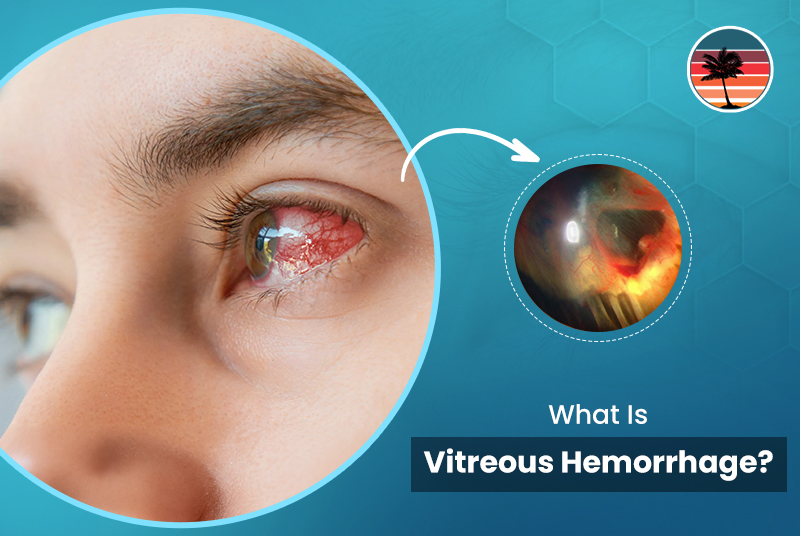
You blink, and your eye looks smoky. Dark streaks drift across your sight, or a haze won’t lift. There’s no pain, which somehow makes it scarier. Painless usually feels safe. This time, it isn’t.
Vitreous hemorrhage means blood has leaked inside your eye, and it’s one of the most common causes of sudden vision loss in adults. Here’s the part most people don’t know: the bleeding itself rarely blinds you. What’s hiding behind it can.
This guide breaks down exactly what’s happening inside your eye, what’s likely causing it, and the one decision that protects your sight: how fast you act. Keep reading before you decide to wait it out.
Quick Answer
Vitreous hemorrhage is bleeding into the vitreous, the clear gel that fills the space between your lens and retina. It causes floaters, dark streaks, or sudden blurred vision. Diabetic retinopathy is the leading cause in adults. Treatment ranges from watchful waiting to surgery, depending on the cause and severity.
Key Takeaways
• Vitreous hemorrhage is bleeding into the gel that fills your eye, and it’s usually painless.
• Diabetic retinopathy is the leading cause in adults.
• Symptoms range from a few floaters to complete vision loss, depending on how much blood there is.
• Treatment ranges from watchful waiting to laser therapy, injections, or vitrectomy.
• Sudden, painless vision changes still need same-day care.
What Happens Inside Your Eye?
Your symptoms make more sense once you know what’s actually being flooded. Here’s the anatomy in plain terms.
Your vitreous is a clear, gel-like substance that fills most of your eyeball. It sits between your lens and your retina, and it’s about 99% water. When a blood vessel in or near your eye ruptures, blood spills into this gel. The blood blocks light from reaching your retina cleanly, which is why your vision blurs or darkens.
This isn’t rare. Vitreous hemorrhage affects about 7 in every 100,000 people each year, making it one of the more common causes of sudden vision loss in adults.
Symptoms: What You’ll Actually Notice
Your symptoms are really a measurement. The more you notice, the more blood has leaked in.
• Mild bleeding: You notice a few new floaters, specks, or cobwebs that drift through your sight.
• Moderate bleeding: You see dark streaks, a red or smoky tint, or sudden flashes of light.
• Severe bleeding: Blood fills your vitreous and blocks most or all of your vision in that eye.
Most people feel no pain. Vision often looks worse in the morning, since blood settles toward the back of your eye overnight and covers your macula.
What Causes Vitreous Hemorrhage?
This is the question that actually matters. The bleeding is a symptom; the cause is the real diagnosis.
• Diabetic retinopathy: The leading cause in adults. High blood sugar damages retinal blood vessels over time. These vessels grow weak and rupture, causing roughly a third to half of all adult cases.
• Posterior vitreous detachment with a retinal tear: As your vitreous ages, it can pull away from your retina and tear a blood vessel in the process.
• Eye trauma: A direct hit to your eye can rupture vessels instantly. This is a leading cause in younger patients.
• Retinal vein occlusion: A blocked vein in your retina raises pressure and can cause vessels to leak or burst.
• Less common causes: These include macular degeneration, eye tumors, sickle cell retinopathy, and retinal macroaneurysms.
How Doctors Diagnose It?
A hazy eye alone doesn’t reveal the cause. Your doctor has to look past the blood to find it.
Your eye doctor starts with a dilated eye exam to check your retina directly. If blood blocks their view, they may use a B-scan ultrasound instead. This safely images your retina through the blood to rule out retinal detachment, the biggest concern. They’ll also check your eye pressure and ask about diabetes, high blood pressure, recent trauma, or blood disorders.
How Doctors Treat Vitreous Hemorrhage?
Once your doctor knows the cause, treatment usually follows the same escalating path.
• Watch and wait: Mild cases often clear on their own. Blood reabsorbs at about 1% per day so that full clearing can take two to three months. Your doctor may ask you to sleep with your head elevated to help blood settle away from your macula.
• Anti-VEGF injections: These stop abnormal blood vessels from growing and leaking further and are often used for diabetic retinopathy.
• Laser photocoagulation: A laser seals leaking or abnormal blood vessels once your retina is visible enough to treat.
• Vitrectomy: If the blood doesn’t clear, or if a retinal tear or detachment is found, a surgeon removes the blood-filled vitreous and replaces it with a clear solution.
What’s the Outlook?
The bleeding doesn’t determine your outcome. What caused it, and how fast you treated it, does.
Vitreous hemorrhage itself rarely causes permanent vision loss. Your outlook depends on the underlying cause and how fast you get treated. Chronic conditions like diabetes or macular degeneration tend to need more follow-up care. Once your retina is treated and the blood clears, your vision usually returns close to normal, unless the retina itself was damaged.
When to See a Doctor?
There’s only one symptom on this list you’re allowed to wait on: none of them.
Call an eye doctor the same day you notice new floaters, dark streaks, flashes of light, or blurred vision, even if it’s painless. Painless vision changes are often the most dangerous, since they can hide a retinal tear or detachment. Don’t wait to see if it clears on its own.
Retina Vitreous Associates of Florida — Quality. Compassion. Trust. Clarity, When It Matters Most.
A hazy eye might clear up on its own. Or it might be the one symptom standing between you and a treatable diagnosis. You won’t know which until a specialist looks.
Retina Vitreous Associates of Florida has diagnosed and treated vitreous hemorrhage for Tampa Bay patients since 1971. Our board-certified, fellowship-trained retina specialists use advanced imaging to find the real cause fast, often the same day, and treat it before it threatens your sight.
Your vision can’t wait on a guess. Request an appointment with RVAF now and get a clear diagnosis from the specialists who see this every day.
Frequently Asked Questions
1. Is vitreous hemorrhage serious?
It can be. The bleeding usually clears on its own, but the underlying cause, like a retinal tear, retinal detachment, or diabetic retinopathy, can threaten your vision if left untreated. See an eye doctor promptly for a dilated exam to confirm the cause.
2. How long does vitreous hemorrhage take to heal?
Mild cases typically clear in two to three months, since blood reabsorbs at roughly 1% per day. Severe cases that don’t clear naturally, or that involve a retinal tear, often need a vitrectomy to remove the blood sooner.
3. What is the most common cause of vitreous hemorrhage?
Diabetic retinopathy is the leading cause in adults, responsible for roughly a third to half of all cases. High blood sugar weakens retinal blood vessels over time, and these vessels eventually rupture and bleed into the vitreous.
4. Can vitreous hemorrhage cause permanent blindness?
Rarely by itself. Permanent vision loss usually comes from the underlying cause, such as a retinal detachment or advanced diabetic retinopathy, not the bleeding itself. Getting treated quickly significantly lowers your risk of lasting damage.
5. Does vitreous hemorrhage hurt?
No. Vitreous hemorrhage is almost always painless, even when it causes sudden, significant vision loss. This lack of pain is exactly why many people delay care, which raises the risk if a retinal tear is the true cause.
6. Can vitreous hemorrhage happen in just one eye?
Yes. It almost always affects one eye at a time, since the underlying cause, like a torn vessel, trauma, or a retinal issue, is typically localized to that eye rather than both at once.