Have you noticed flashes of light or new floaters in your vision recently? Or perhaps a shadow has appeared in your vision? If so, you may have been considering a retinal tear or retinal detachment and wondering whether you need emergency attention.
These are two very similar conditions that can be tricky to differentiate, but recognizing the difference can help protect your sight by enabling you to take quick and effective action.
It is possible to treat a retinal tear without causing damage. In this respect, retinal detachment is more serious due to the risk of permanent loss of sight if not treated urgently.
In this guide, the differences are explained, along with warning signs and treatment.
Quick Answer
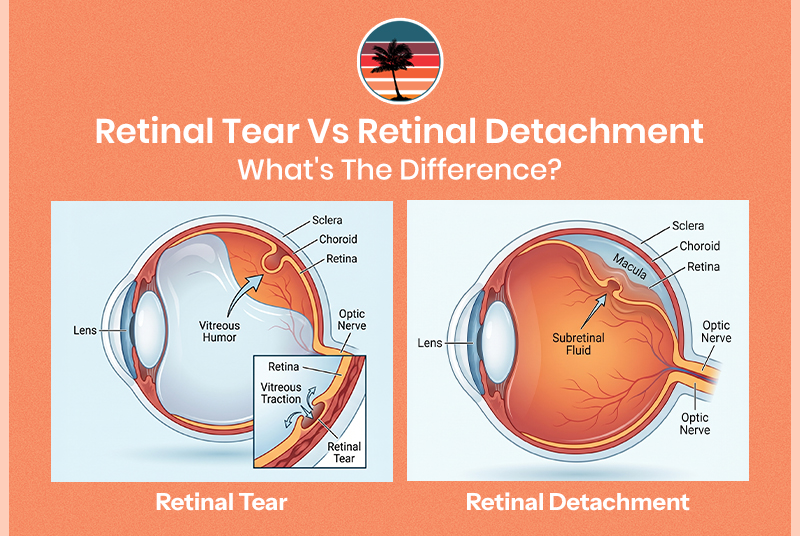
A retinal tear is just what it sounds like – a small gap in your retina (the layer of light-sensitive tissue at the back of the eye). A retinal detachment happens when your retina pulls away from the other layers beneath it.
Both conditions need to be treated quickly, but retinal detachment is a sight-threatening emergency and usually needs surgery.
Retinal Tear vs Retinal Detachment at a Glance
This chart is included so that patients can easily understand the major differences between the conditions prior to a more in-depth discussion of each.
|
Feature |
Retinal Tear |
Retinal Detachment |
|
Definition |
A small break or rip in the retina |
Separation of the retina from the underlying tissue |
|
Vision Impact |
Vision may remain normal at first |
Vision loss often occurs |
|
Common Symptoms |
Flashes, floaters |
Flashes, floaters, curtain, or shadow in vision |
|
Severity |
Serious condition |
Medical emergency |
|
Treatment |
Laser treatment or cryopexy |
Surgery or other retinal procedures |
|
Risk to Vision |
Can lead to detachment |
Can cause permanent vision loss |
|
Recovery Time |
Often shorter |
Usually longer |
What Is a Retinal Tear?
It becomes simpler to understand why retinal tears require rapid treatment once the cause is identified.
Retinal tears are caused by the development of a hole or rip in the retina.
The retina is found at the back of the eye. It is responsible for detecting light and sending impulses to the brain, enabling us to see. The substance inside the eye (the vitreous) shrinks with aging and starts pulling away from the retina (a PVD – posterior vitreous detachment), and occasionally pulls on the retina hard enough to tear it.
Retinal tears do not necessarily cause vision loss at first. Still, they can allow fluid to seep behind the retina, eventually causing retinal detachment.
What Is a Retinal Detachment?
If the retina has torn, you have a retinal tear; if the retina has come away, this is known as retinal detachment and is a more serious condition that can endanger your eyesight.
Retinal detachment is a condition in which the retina detaches from the layers behind it.
The retina requires oxygen and nutrients from the blood vessels near it to keep retinal cells alive. When the retina detaches, these blood vessels cannot provide the required support to the retina.
Without medical treatment, retinal detachment can result in a permanent loss of sight.
Retinal detachment usually results after a retinal tear. However, previous eye surgery, eye injury, or certain eye diseases can also cause it.
How a Retinal Tear Can Become a Retinal Detachment?
To the surprise of many patients, these are often related to the same underlying illness process.
Most people assume that these are separate conditions. However, often they are simply different manifestations of the same illness. This is what the general progression looks like:
- Vitreous gel degenerates with time.
- The degenerating vitreous starts pulling on the retina.
- The retina develops a tear.
- Liquid gets through the retinal tear.
- The retina is pulled off the back of the eye.
- Retinal detachment happens.
This can happen over days, weeks, or months, but it can also happen quickly. This is why doctors treat retinal tears before they become more serious conditions.
Symptoms of a Retinal Tear
The symptoms of a tear can come on very quickly or build slowly over time. Identifying the initial signs of a tear can help you receive treatment before more serious effects occur.
Symptoms of a retinal tear may include:
- Sudden flashes of light.
- New spots that can be referred to as floaters.
- A sudden, rapid increase in the amount of floaters.
- Blurred vision
- Loss of peripheral (side) vision in some individuals.
Floaters can appear as:
- Black spots
- Tiny dots
- Cobwebs or strings
- Tadpoles
In some cases, you might experience just a couple of these symptoms. In others, all of them can come on in one big bunch.
Symptoms of a Retinal Detachment
The symptoms of retinal detachment will most commonly become more evident over time, making them easier to notice.
The signs and symptoms of retinal detachment are more likely to worsen over time.
Symptoms can include:
- Flashing lights suddenly appear.
- More and more floaters suddenly appear.
- Blurry vision is noticeable.
- Side vision is lost.
- A gray shadow moving across vision.
- A “curtain” like phenomenon in part of the visual field.
- The person is suddenly blind.
The “curtain” symptoms are among the most crucial to look out for. Immediate emergency eye treatment will be necessary if any signs of a shadow, curtain, or darkened area are observed moving through the person’s vision.
Symptom Timeline: What Usually Happens First?
Although each case is unique, you may recognize a certain progression of symptoms as indicated to diagnose the disease
By learning about how symptoms develop, you’ll learn what you might be going through:
Early stage of disease: You may or may not recognize:
- Several flashes of light.
- Recent appearance of new floaters.
- Minor visual changes.
Intermediate stage of disease: The following symptoms might be present:
- Numerous floaters appear.
- You experience regular flashes of light.
- You have more and more vision disruption.
Advanced stage of disease: When the retinal detachment begins to grow:
- The image in the eye appears to be obstructed by a shadow.
- Your peripheral vision begins to diminish.
- A curtain or shading effect becomes evident.
Emergency stage of disease: In cases of severe retinal detachment, you may experience:
- Sudden or profound loss of central vision.
- Severe visual impairment (you may not be able to distinguish fine detail in an image or see small objects at the center of your eye).
- Irreparable visual damage if medical care is postponed.
When Is It an Emergency?
Time is of utmost importance for saving your sight. Some symptoms should never be overlooked.
A sudden change in your vision should be seen as an emergency.
See an eye specialist urgently if you have a:
- New appearance of lights.
- Sudden floaters
- A sudden increase in floaters.
- A curtain in your field of vision.
- Loss of your peripheral vision.
- A veil drawn across your vision.
Do not wait and see if they get better; it is imperative that they are seen immediately, as prompt treatment gives the best chance of preserving sight.
Causes and Risk Factors
Retinal tears and detachments can occur in anyone, but certain circumstances may put someone at greater risk.
There are many risk factors for retinal tears and retinal detachment:
- Age: As we age, the vitreous becomes more prone to breaking down.
- High Myopia: People with severe nearsightedness are at greater risk because their retinas can become thinner.
- Previous Eye Surgery: Some surgeries may lead to retinal complications.
- Eye Trauma: Blunt trauma can exert significant force on the eye, causing tears.
- Family History: A family history of retinal detachment increases your risk.
History of retinal tear or detachment in one eye.
How Do Doctors Diagnose Retinal Tears And Retinal Detachments?
Comprehensive eye exams are performed to determine whether there is any retinal damage and what type of treatment is necessary.
An ophthalmologist will administer a comprehensive dilated eye exam.
Diagnostic tests are performed, which may consist of:
- Dilated retinal exam
- Indirect ophthalmoscopy
- Optical coherence tomography (OCT)
- Ocular ultrasound in some cases
The results of these tests are used to identify tears and diagnose detachments, helping determine the best treatment option.
Treatment for a Retinal Tear
A retinal tear will frequently develop into a retinal detachment, but this is not inevitable.
It is common for a retinal tear to be treated before it progresses to retinal detachment.
1. Laser photocoagulation
Small burns are made around the tear with a laser.
These scars effectively seal the retina down in position.
2. Cryopexy
This is where the tear freezes, producing a scar around it that prevents fluid from flowing through.
Treatment for retinal tears is usually provided on an outpatient basis.
Treatment for Retinal Detachment
Since retinal detachment can result in vision loss, the main aim of treatment is to reattach the retina as soon as possible.
Retinal detachment usually involves more intrusive treatment methods;
1. Pneumatic Retinopexy
A gas bubble is used to push the retina back into place.
2. Scleral Buckle Surgery
A small silicone band is used to support the outer wall of the eye.
3. Vitrectomy
The surgeon removes the vitreous gel and attaches the retina.
The procedure used will vary depending on the size of the detached area of the retina.
Recovery and Outlook
Recovery can vary from person to person, but timely intervention generally offers a good chance of retaining vision. Recovery depends on the speed of treatment and whether the macula (the center part of the retina) remains attached.
Prognosis of Retinal Tear
Treatment can prevent retinal detachment and vision loss.
Prognosis of Retinal Detachment
Most patients will regain useful vision after surgery. Vision depends upon:
- The length of time the retina was detached.
- Whether the macula was involved.
- Degree of damage to the retina.
The earlier it is treated, the better the prognosis.
Retina Vitreous Associates of Florida — Preserving Vision. Protecting What Matters Most.
While a retinal tear and a retinal detachment have symptoms that appear to be the same, the distinction between them could mean the difference for your vision. Remember, never ignore any floaters, flashes of light, shadows, or abrupt changes in your sight.
The earlier you seek evaluation from a retinal specialist about your symptoms, the more treatment options will likely be available and the higher chance you will have of retaining your sight.
Do not wait to schedule an appointment to be seen by one of the trained retina specialists at Retina Vitreous Associates of Florida if you suspect that you have a retinal tear, retinal detachment, or have had an abrupt change in your vision.
Frequently Asked Questions
1. Can A Retinal Tear Heal On Its Own?
No. Tears usually do not heal on their own, and if left untreated, the fluid can pass through the tear, causing the retina to pull away from the back of the eye. An eye doctor should see any possible tears immediately.
2. Is Retinal Detachment An Emergency?
Yes. Retinal detachment is considered an emergency condition, as blindness can be irreversible. Early treatment may save sight and reduce the extent of retinal damage.
3. How Do I Know If I Have A Retinal Tear Or Retinal Detachment?
Either condition can lead to flashes of light and floaters. Retinal detachment usually causes several additional symptoms, such as a shadow- or curtain-like effect, decreased peripheral vision, and sometimes sudden vision loss. A dilated fundal examination is the only way to diagnose the problem.
4. How Quickly Can A Retinal Tear Become A Retinal Detachment?
A retinal tear could lead to retinal detachment within days, weeks, or months. The duration depends on the size and site of the retinal tear. If management is timely, the risk of further progression decreases.
5. Can Vision Return After Retinal Detachment Surgery?
Useful vision can be recovered in many patients post-surgery for retinal detachment; the success of which depends on the duration of detachment, whether the macula is involved, and the immediacy of the intervention.