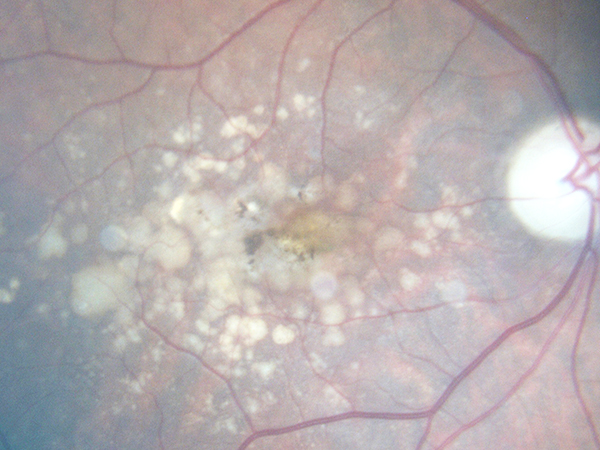
Intermediate dry age-related macular degeneration (AMD) is a stage of the disease in which yellow-white deposits called drusen accumulate beneath the retina, as seen in the image above. These drusen can vary in size, and as they grow larger and more numerous, they begin to disrupt the delicate layers of the retina responsible for central vision. Pigment changes in the macula may also develop during this stage, signaling further stress to the retinal cells.
While some individuals with intermediate dry AMD may not yet notice significant changes in their eyesight, others can begin to experience blurred or distorted central vision — making everyday tasks like reading, driving, and recognizing faces more difficult. Without intervention, intermediate dry AMD carries a meaningful risk of progressing to advanced stages, where more severe and permanent vision loss can occur. Early treatment with therapies like Valeda Light Therapy may help slow this progression and preserve your vision.
Dry Age Related Macular DegenerationValeda Light Therapy uses a process called photobiomodulation (PBM) to deliver three specific wavelengths of light — yellow, red, and near-infrared — directly to the retina. These wavelengths work at the cellular level to boost energy production in the retinal cells, reduce harmful oxidative stress, and calm inflammation that contributes to the progression of macular degeneration. By revitalizing the cells that support the macula, Valeda helps restore healthier retinal function from the inside out.
Can Valeda Improve Vision?
Yes — clinical studies have shown that Valeda Light Therapy can meaningfully improve vision in patients with dry AMD. In the landmark LIGHTSITE III clinical trial, patients treated with Valeda gained an average of over 6 letters on the eye chart at 21 months, with more than 60% of treated eyes achieving 5 or more letters of improvement and nearly a quarter gaining 10 or more letters. Patients also reported significant improvements in their overall quality of vision in daily life. Beyond improving vision, Valeda was shown to reduce drusen — the deposits beneath the retina that drive AMD progression — and significantly lower the risk of advancing to geographic atrophy, a more severe form of the disease. The treatment has demonstrated a strong safety profile with no signs of phototoxicity across multiple clinical trials.
This treatment is offered at our St. Petersburg location: (727) 323-0077

How Is Valeda Light Therapy Administered?
Valeda Light Therapy is a painless, non-invasive treatment performed right in your eye doctor’s office — no injections, no surgery, and no downtime. During each session, you simply sit comfortably and look into the Valeda device, which delivers three precise wavelengths of therapeutic light (yellow, red, and near-infrared) to the retina. Each eye is treated individually, and a single session takes only about 3 to 5 minutes per eye. No special preparation is needed, and you can return to your normal activities immediately afterward.
How Many Treatments Are Needed?
A standard course of Valeda treatment consists of 9 sessions delivered over approximately 3 to 5 weeks — typically 3 sessions per week. This initial series is then repeated every 4 months to maintain and build upon the therapeutic benefits. Clinical studies have shown that ongoing treatment cycles are important for sustaining vision improvements and continuing to slow the progression of dry AMD. Your eye care provider will monitor your response and tailor the treatment schedule to your individual needs.
Many insurance plans now provide coverage for Valeda Light Therapy as a treatment for dry age-related macular degeneration. Coverage may vary depending on your specific insurance provider and plan, so our team will work directly with your insurance company to verify your benefits and obtain any necessary approvals on your behalf.
We understand that navigating insurance can be stressful, and we want to make the process as seamless as possible. Our office staff will handle the paperwork and prior authorizations so you can focus on what matters most — protecting your vision. If you have any questions about your coverage or out-of-pocket costs, please don’t hesitate to contact our office and we’ll be happy to help.