You’re reading the fine print from a drug bottle when the letters begin to blur. Lines on a window frame appear suddenly wavy. Your loved one’s face becomes less recognizable.
If these situations sound familiar, you might be up against age-related macular degeneration (AMD) — a common condition in older adults — and you can learn more about its symptoms and treatments here: age-related macular degeneration (AMD).
The scary part? Nine out of every ten people won’t learn they have AMD until it’s underway. The more fearful news? There are two types of this condition, and one can lead to permanent central vision loss if not treated promptly.
Wet vs. dry AMD can be the difference between keeping your independence and losing the ability to drive, read, or recognize faces. Knowing the two forms of AMD is practical information that may help save sight.
Understanding Dry AMD
Dry AMD is the most common form of AMD. It advances slowly and often goes unnoticed at first.
Significant features of dry AMD:
- Accounts for 85–90% of all AMD cases.
- Progresses slowly over months or years.
- Caused by the thinning of macula cells with age.
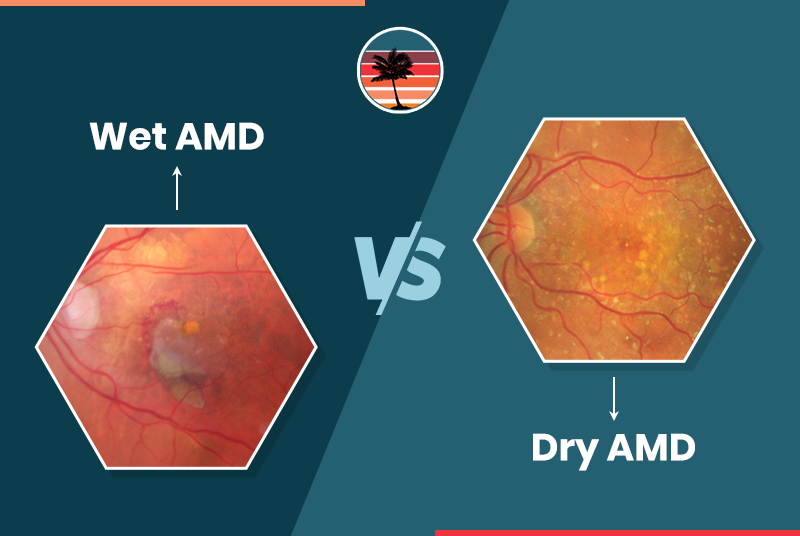
- Produces yellow deposits called drusen under the retina.
- Vision decline is gradual and less severe.
Most people with dry AMD start with mild symptoms. Reading may look slightly blurry, and low light makes it harder to see. Colors may look less vibrant. It almost always affects both eyes, though one eye can be worse.
Typical indicators are:
- Worsening central vision.
- Needing more light to read.
- Trouble seeing faces.
- Slight waviness in straight lines.
- Colors seem pale or dull.
There’s no current treatment that reverses dry AMD. Diet changes and specific supplements may help slow progression.
Understanding Wet AMD
Wet AMD is less common but more serious. It needs urgent medical care to prevent significant vision loss.
Significant characteristics of wet AMD:
- Makes up about 10–15% of AMD cases.
- It can worsen quickly in days or weeks.
- Driven by abnormal blood vessel growth under the retina.
- These vessels can leak fluid or blood, potentially damaging the macula.
- It can rapidly lead to central vision loss.
Wet AMD develops when fragile new blood vessels grow under the retina, a process called neovascularization. These vessels often leak and scar, which harms the macula.
Warning indicators of wet AMD:
- Sudden vision changes.
- Straight lines appear wavy or bent.
- Blank or dark spots in central vision.
- Fast central vision decline.
- Colors look less bright.
The good news: early treatment can be very effective. Doctors commonly use eye injections to halt abnormal vessel growth.
Side-By-Side Comparison
| Feature | Dry AMD | Wet AMD |
| Frequency | 85-90% of cases | 10-15% of cases |
| Progression | Slow, gradual | Rapid, sudden |
| Main cause | Cell death and drusen | Leaking blood vessels |
| Vision loss | Usually mild to moderate | Can be severe |
| Treatment | Lifestyle changes, supplements | Eye injections, urgent care |
| Urgency | Regular monitoring needed | Medical emergency |
Risk Factors and Prevention
Shared risk factors:
- Age over 60.
- Family history of AMD.
- Smoking.
- High blood pressure.
- Obesity.
- Prolonged sun exposure without eye protection.
Prevention tips:
- Eat leafy greens and seafood.
- Take AREDS2 vitamins if your eye doctor advises.
- Wear UV-protective sunglasses.
- Exercise regularly.
- Keep a healthy weight.
- Quit smoking.
When to See a Retina Doctor?
Regular eye exams matter after age 60, especially if you have risk factors. Early detection helps manage both types of AMD better.
Seek care right away if you notice:
- Sudden vision changes.
- Straight lines look wavy.
- New dark spots in central vision.
- Fast loss of sharp vision.
A specialist can run tests to confirm the presence of AMD and its type. For dry AMD, regular monitoring tracks changes. For wet AMD, early treatment protects remaining vision.
Living with AMD
Many people stay active with the proper care and support. Low-vision devices, better lighting, and simple techniques can help with daily tasks. Support groups and vision rehab also help people adapt.
Stay close to your eye care team, follow treatment guidance, and keep up with advances in retina care to protect your sight and quality of life.
Your Eyesight Deserves Professional Help
Don’t wait for symptoms to worsen. AMD is progressive and needs attention from experienced eye specialists who understand the nuances between wet and dry forms. Early care may help you avoid severe vision loss and maintain independence.
If you notice changes in central vision, see wavy lines, or struggle with fine work, get professional help. The retina specialists at RVAF use modern technology and proven treatments to safeguard your vision. Book your comprehensive eye test today at https://rvaf.com/ — every day counts for your vision.